
Why Do Western and Eastern Societies Perceive AI So Differently?
It's a question I've always wondered about.
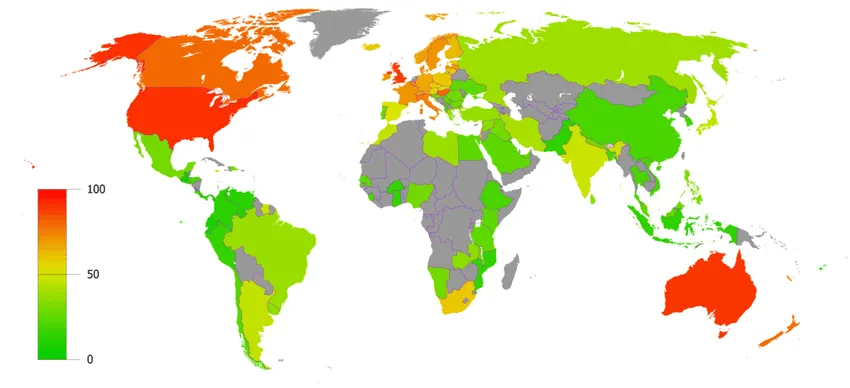
(Individualism index: Western cultures score high on individualism, while Eastern cultures score low)
When I talk with Western friends on Discord or through other online channels, I'm often surprised by just how strong their opposition to AI is. They come at it from a perspective of intellectual theft and exploitation, starting with things like "using AI is stealing," and the hostility they express is intense.
Out of curiosity, I've reached out to contacts on WeChat in China or talked with friends in Korea, and they tend to hold a favorable view of AI. Even if there are aspects of coding that put Asians at a disadvantage, I don't think China's brightest minds have been suffering from that, so why would they be supportive of AI when it could eliminate their jobs?
When I actually think about it, I have a few hypotheses forming in my head. Basically, Asian societies like South Korea and China have dominant groups, whether chaebols or the Communist Party, and social success is closely tied to being recognized by those groups. Since the power of those groups rests on a kind of national competitiveness, favorable public opinion naturally follows from that. Meanwhile, could it be that in Europe and the United States, what matters most is fair compensation for labor and the right to self-determination?
I both like and dislike AI, but if I had to pick a side, I'd say I like it. In my case, since I'm not tied to a company, periods of transition and upheaval can themselves be opportunities.
Could it be a matter of Individualism versus Collectivism?
The first thing that came to mind was cultural difference.
In Hofstede's Cultural Dimensions Theory, the United States and many Western European countries score high on individualism, while South Korea and China score relatively low.
Out of curiosity, I looked it up, and according to Stanford's 2025 AI Index, 83% of respondents in China said the benefits of AI products and services outweigh the drawbacks, compared to just 39% in the United States. The 2026 Ipsos survey similarly found that countries in Asia and Latin America were relatively favorable toward AI, while anxiety and wariness were stronger in Europe and North America.
Kiss and Rosa-García, in their 2025 working paper, compared survey results from 47 countries against democracy indicators and reported a correlation in which higher levels of democracy were associated with lower AI acceptance and lower trust ratings. Even in models that controlled for income, education, and AI-related knowledge, the relationship between acceptance and trust ratings persisted. Source paper
From this perspective, it seems that what matters is how narratives survive and take hold.
I think this is ultimately a question of hegemony.
China is a country where the Party-State stands above the law, and counter-narratives are suppressed. I have no intention of disparaging China, and in the sense that the entire Party leads a vast nation, there is an efficiency to it, but corporations are also instruments subordinate to the Party. In that respect, the importance of the political system is high, and the legitimacy of that extralegislative authority requires some degree of recognition and validation from other nations. From that angle, the idea of making China great means, in other terms, that China must excel or lead in certain metrics compared to other countries. I've actually heard that under something called AI+, China is integrating AI into six key sectors.
In South Korea, the chaebols essentially have a grip on the press, and it is a country where narratives unfavorable to the chaebols or to corporations generally don't get much traction. Media outlets are actually owned by construction conglomerates, and since Korea directly benefits from semiconductor cycles, counter-narratives get pushed to the margins in the name of corporate survival. As a result, dissenting voices find themselves in a position where they struggle to gain any real resonance.
Countries that score high on global AI acceptance indices generally face productivity pressures from aging populations, but across the board there is also a tendency for governments to actively cultivate AI optimism.
Beyond that, Collectivist cultures and traditions that emphasize long-term national planning reinforce AI optimism. Cross-cultural research suggests that collectivist societies tend to be more optimistic about AI than individualist Western societies, and this can be attributed to a cultural emphasis on social harmony and long-term national planning.
On the other side, the United States makes more AI than anywhere else yet is also one of the most anxious about it. The biggest reason Americans don't use AI isn't accessibility (55%) or a sense of threat (12%), but lack of trust (70%)1.
Many statistical sources point to a perception gap between those who build AI and those who live alongside it, and people perceive that neither government nor corporations can be trusted to regulate AI responsibly.
Cultural narrative also plays a significant role. America's AI imagination leans toward the dystopian extreme. The "robot apocalypse" narrative, epitomized by The Terminator, has dominated the genre and shaped the very frame through which the public perceives AI. Skynet aside, academic analysis points out that American AI narratives tend to polarize into "utopia or (more often) dystopia." In other words, many Americans first imagine AI not as "a tool I can use" but as "a force that will replace me."
Looked at from the other direction, this means that at the root of Western and American fear lies a hegemony of culture generated by citizens who cannot be controlled. The Trump administration and the state argue that AI is necessary for national competitiveness, but the media power and public opinion that America itself produced can be turned around to interpret AI as a threat to the individual.
On top of that, there is likely the labor-centered ethos and the Stoic philosophy woven into everyday life that is characteristic of Christian cultural communities.
The United States has been the country that produced the world's narratives for the past century. Hollywood decided what was cool, Silicon Valley decided what the future looked like, and the tech media decided what counted as innovation.
But as these elements combine with individualism, the result is a structure where supporters fracture easily, and the collision of divergent public opinions becomes a kind of persistent state of anxiety.
Technology companies promise a future where AI overcomes human limitations, but creators and workers can reasonably wonder whether their work and livelihoods are being unilaterally consumed to build that future.
As these narratives combine with individualism, a structure forms in which people easily split along fault lines depending on whose freedom and rights should take priority when it comes to the same technology. Those who assert the freedom to use technology clash with those who assert the right to control their own labor and creative works. Could it be that this ongoing collision of competing rights claims, unable to converge into a single social consensus, is precisely what amplifies the anxiety surrounding AI?
In South Korea and China, by contrast, AI tends to be seen as an opportunity to catch up with or overturn the existing world order, and because that framing is grounded in individual sacrifice and dedication to the collective concept of the nation, it may also be easier to form a unified public consensus.
That said, these ideas are fragmentary and not definitive answers. The variables to consider in research like this are endless, and outcomes will differ vastly depending on each country's industrial structure, economic level, political system, and individuals' occupations and social positions. I think the reasoning holds together, but this is also a piece with plenty of holes.
In any case, I think I like AI.
As I mentioned earlier, I'm not employed by any organization, nor do I hold a special position within an existing company or industrial structure. AI might replace some of what I do, but it also makes possible things that would have been difficult for me to even attempt on my own before. Beyond that, it gives me as an individual developer the opportunity to take on bigger projects. So I tend to think of this period of confusion as a chance to climb a few rungs up the ladder.
I can work with computers, and in capitalist terms, a computer is a kind of means of production capable of generating output.
Part of the reason there were so many individual startups in the IT industry in the early 90s and 2000s was fundamentally that the means of production were accessible to individuals. But as the industry matured, the quality and scale demanded of products grew, and it became increasingly difficult for individuals to compete with organizations. Then AI arrived. There are still plenty of limitations, of course, but the possibility has opened up for individuals to attain something close to an organization's productive capacity.
Conversely, if I had a company that society recognized, people I loved, and a home, I think I probably would have been fiercely critical of AI for infringing on my rights.
I always think about it, because I'm selfish like that.
Still, I find it fun to chat with Westerners from time to time. They find me tiresome, but the fact that they're different from me is what I enjoy.
Footnotes
- https://blockchain.news/ainews/AI%20adoption%20barriers ↩