
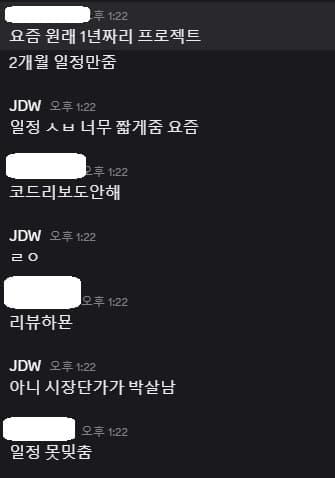
(My friend who works at a major IT conglomerate, saying even his own company runs on vibe coding)
These days, vibe coding is the default in the market.
My friend works at a large company, one of the top IT firms in Korea, and he says they don't even do code reviews anymore. Everyone around him is the same. Even Chinese developers now just hand me AI-generated answers directly. Apparently that's more efficient... and these are people who graduated from China's top universities.
I feel deeply anxious. I fully switched to vibe coding after GPT 5.2. To be precise, when GPT 5.2 came out on December 11, I started testing the transition to AI coding, and by March of this year I had made a complete switch. The reason for this major shift is that, according to Pragmatic Engineer survey results, over 95% of respondents said they use AI every week, and over 75% said they use AI for more than half of their software work.1
More precisely, market pricing itself is now benchmarked against vibe coding. Projects that used to take three months now take one month. The problem is that vibe coding has driven so many people out of the field that there's now a line of people eager to take the work.
This site, makonea, is still hand-coded manually, but all of my side projects created recently are built on AI coding.
Even the compiler project I was working on has moved from manual coding to full vibe coding.
I don't use AI when submitting pull requests to other people's projects, but I keep using AI throughout all of my own projects. For client delivery projects, I use it because deadlines have become too tight; for other projects, I use it because the problems are too hard.
AI codes far better than I do. I've studied hard, but since GPT 5.2, or more precisely since 5.3, I have not beaten it even once on short coding tasks.
The problem is that the more I use AI, the more I start to forget how to write code myself. The more I rely on vibe coding, the more I sense I'm losing the ability to review code, so I keep up manual coding for about 30 minutes to an hour each day.
But hobby coding that isn't aimed at shipping a product leaves no lasting memory. So I'm genuinely worried about how to prevent this muscle atrophy.
The community around me, people from East Asian backgrounds, are more receptive to AI coding than I expected. Most people around me are. The reason is simple: East Asian developers always found it hard to express themselves within a programming culture built on Western conventions, so self-expression through code was already a struggle. Most of us coded by copying and pasting from Stack Overflow, and most of us were constantly chasing deadlines.
Since we were mostly at the mercy of library and framework authors in the United States, what we were really doing was pulling in libraries and frameworks and assembling them, which isn't all that different from vibe coding.
Of course, with natural language coding you only need to watch the structure, so there's little reason to dislike it. In contrast, I sense that Westerners push back hard against AI coding. For them, coding is a symbol of intellectual sovereignty, and directly controlling and understanding code was core to their identity as developers. AI coding outsources that intellectual sovereignty, so the resistance makes sense.
Seen from that angle, I sense a divide between those who had the freedom to choose not to do AI coding and those who never had a choice but to do it. AI coding has made the very difficult skill of code implementation cheap.
Even just three years ago, "implementation" felt like something only a chosen few could do. So those of us who, like me, assembled libraries and fit pieces into existing frameworks were often looked down on, dismissed with words like "code monkey" and other insults.
Even for me, implementations that now take a minute used to take five or six hours. Implementing random map generation using Binary Space Partition for the first time took a whole week. Now it's done in three minutes, and the algorithm it chooses is far better than what I came up with back then.
So it's perhaps no surprise that, since AI arrived, the symbolic capital attached to the skill of implementation has started collapsing, and the Western engineers who were largely responsible for that implementation are beginning to feel outraged by it.
I'd probably feel the same way. Who would be happy watching capital they worked hard to accumulate suddenly crash in value?
But I've been able to implement so many things I wanted to implement but couldn't before. And since the AI doesn't get annoyed when I ask about the underlying principles, I've been able to learn and build far more than I could before. On that point, I have a genuinely positive view.
Of course, I might be among the first to be cut because of AI. But I'm ready to accept that humbly. I don't have much to lose anyway.
In any case, AI writes better code than I do and produces fewer bugs. When you trace through the code as a whole, the patterns can look strange, but when you map out the overall implementation, the structure is mostly coherent and makes sense.
The problem is that its abstractions are too different from mine. So once AI starts writing code, my code and the AI's code grow increasingly incompatible, and I end up having to choose between one or the other.
I usually choose the AI code. The abstractions differ, but AI code is overwhelmingly more productive, and much like the Ship of Theseus, the AI code gradually takes over the entire project and shifts its abstraction. What's sad is that this is actually the more rational choice. The training data AI learned from is primarily enterprise-scale code, so the result is a program suited to a larger scale than anything I would have built on my own.
Of course, if something strikes me as genuinely strange, I cut out that abstraction, but most of it makes sense, so I just let it run.
So lately I don't really know how I feel. I know that depending on vibe coding is chipping away at my skills, yet I can't bring myself to step away from the market demands or the pleasure of implementation.
I know that gaining knowledge is painful, yet I still don't want to go back to the way things were. I don't want to return to a life where reading a five-page paper takes four hours. Now I can translate and read an entire paper in ten minutes. That's why I don't want to go back.
Why is life always this painful? I wish there were something I could choose with just a little more peace of mind.