
I had a job interview recently.
It was for a lifelong education center, teaching seniors how to use AI tools.
These days there's less demand for programmers, but I've been getting inquiries asking me to teach AI usage. Most of them want to know how to use Claude Code.
It's 330,000 won for a two-hour lecture. With travel expenses included, that comes to 360,000 won.
The job is simply to explain how to use Claude Code and put together a presentation with some basic examples.
I felt a deep sense of self-reproach. Is this really what I studied for, just to teach other people how to use a product?
It's always like this. The knowledge I consider important doesn't make money, while the kind of knowledge you pick up just by spending time carefully reading an official website actually does.
My interests and what the market wants don't align. It's almost funny that someone would pay for a lecture on something you can figure out just by reading and installing things yourself, but there's no one else around here who could be called a programmer, so the work keeps coming my way and I can't turn it down.
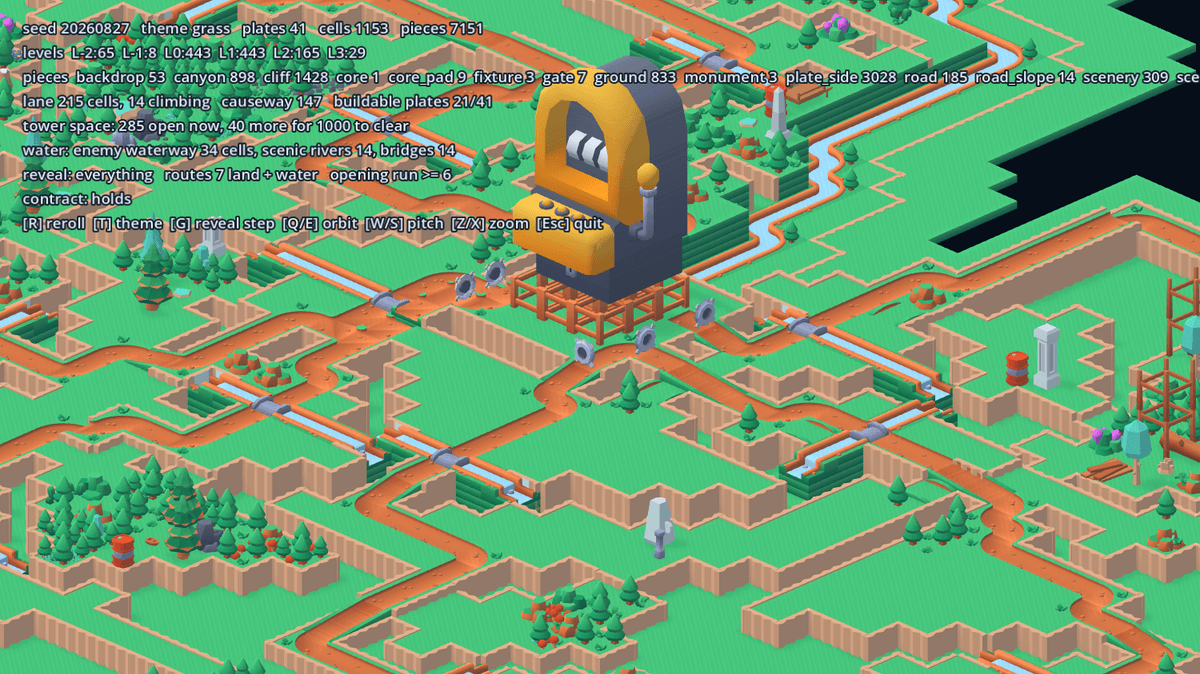
Lately, to cope with depression, I've been spending my free time making a game. A few commissions fell through, and I can't keep working only for other people indefinitely.
It's a Tower Defense game, and I want the maps to be randomly generated, but the 3D map generation still isn't working the way I want. Laying out a 2D map with 3D blocks is manageable, but making that look beautiful along the Z-axis in full 3D feels like an entirely different problem.
But because I'm a programmer, I need to complete the Procedural Generation logic if I want to create a sense of volume with a minimal number of Assets.
I'm trying to combine existing Assets and make everything Modular, but it's not easy.
These days, developers using AI are making games with far better ideas and concepts than mine. They can code to some degree but get stuck at genuinely difficult implementations, whereas my weakness is on the ideas side. It gives me a lot to worry about.
Things like placing towers and having them attack are implemented fine, but getting the automatically generated maps to actually look good is something I keep debugging, and it's proving difficult.
Using AI doesn't resolve it all that well either, and I can't keep carving out free time indefinitely. I'm doing my own User Modeling, checking the budget I can work with and marketing statistics as I build, but whether it will succeed is anyone's guess. Honestly, I don't think it will be a big hit, the UI included.
Did I model the player too naively?
I'm building the game based on genre statistics and purchase rates, but separate from that, the artistic genre of the game is also a problem.
And even if I nail the buyer modeling, whether the game can actually deliver fun to players is a separate question entirely.
There are so many variations and trends in Tower Defense right now, with such diverse concepts, and whether I can deliver real fun using recycled Assets is yet another question. I have a lot on my mind.
Thinking about the fun factor, the Balance, how to capture a player base, and cataloging the various types of modern Tower Defense games, my head got completely overloaded.
Seeing the popularity of Sir, We Have an Orc Problem made me think even harder. There are so many other interesting games out there too. Goldroot in particular surprised me when I first saw it. In the end, real artistic skill is what's needed, and figuring out what I should do is proving harder than I expected.
On top of that, AI has raised the minimum bar that even the lowest-priced products need to clear. The planning wall has gotten even higher for indie developers like me.
People often say that using AI saves time, but the more AI is used, the better everything has to be. People's baseline standards have risen, and games that are just decent won't sell. Yet if you use AI-generated Art, the statistics show that people won't buy the game either.
And I don't have money to hire someone for Assets or illustration work, and given the nature of living in the provinces, there simply aren't artists like that nearby, which is another problem.
It's a gloomy night. How do I introduce variations within the Genre Convention, and will those variations actually be fun? And can I make the game something players will want to replay again and again? I keep turning it over in my mind.