
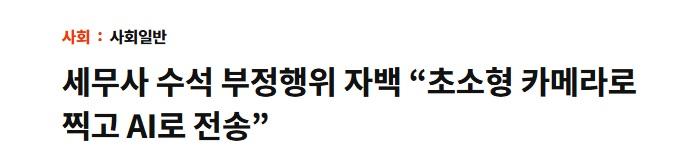
The top scorer on this year's Certified Tax Accountant (CTA) exam received a perfect score on the Introduction to Tax Law section, while the average score among all examinees was 30 points. The situation stirred up considerable controversy, and then suspicions emerged that the candidate had used a micro camera to cheat with AI assistance — suspicions that ultimately turned out to be true. The irony is that the cheating was exposed precisely because the exam difficulty was so extreme that practicing tax accountants and top instructors were saying it was impossible to score a perfect mark, and that skepticism snowballed until the candidate eventually confessed.
The process by which the top-scoring CTA candidate's cheating was uncovered reads like a black comedy. The decisive trigger that tripped him up was the industry's collective disbelief: "It is physically impossible for even a seasoned veteran or the best-known instructor to score a perfect mark within the allotted time."
Some argue that this shows the exam is working correctly, since it was able to filter out an abnormal score. I see it differently. When practicing professionals and the vast majority of examinees cannot break an average of 30 points, yet an AI scores 100, that tells you the exam is not measuring the validity of real problem-solving ability; it is functioning as a filter designed purely to screen people out.
An exam is, by its original purpose, a gatekeeping instrument that verifies the minimum qualifications needed to perform a given profession. But when the market's share of the pie is fixed and competitors flood in, incumbents must raise the walls to control supply. The result, I believe, is that the exam loses any connection to actual practice and becomes a monster armed with grotesquely distorted traps and time pressure whose sole purpose is to make people fail.
The same is true of the CSAT, and of early-stage exam formats in general: early entrants always have an advantage, while latecomers are at a disadvantage. I have always thought this, even accounting for the fact that in the early days of sparse infrastructure it was genuinely harder to find the knowledge needed to study.
Whenever a profession is prestigious and attracts a large pool of applicants, there is always a need for the most quantifiable pretext to cut candidates down. That is precisely what credentials like these are for.
So what, exactly, does a credential prove?
The abilities a tax accountant should genuinely possess are understanding tax law, resolving complex tax problems, and taking responsibility for one's own judgment. But does continuously raising the difficulty of the exam actually let us measure those abilities more accurately?
I have ADHD, which makes memorization difficult for me. That is clearly a weakness of mine, and it puts me at a disadvantage on exams. Does that make me a useless person in society? I do have some capacity to "create" things. Though even that ability emerged largely by luck. In reality, I never had opportunities to demonstrate it; it manifested because the circumstances, by pure chance, happened to align with what I could do. In that sense, an exam score is not so much a standardized measure of human potential as it is a single photograph taken under a specific set of conditions.
The reason I believe I have some capacity to create is that I have outputs to show for it. My homepage is a 140,000-line site with both the front end and back end fully implemented by myself, and among the things I have built are a 60,000-line ERP system, as well as code that has been deployed in an actual tax law firm, in labs at Seoul National University, Korea University, and several other universities with faculty involved in startup ventures.
Living in society, what I keep noticing is that the abilities people consider important are largely managed through memorization and quantified metrics, and I always wonder whether that can truly standardize the full potential of all human beings. Does doing well on CSAT problems as a child make someone a genius? Does being good at simple rote memorization alone make someone smart?
When I was living in a goshiwon in Sindang-dong, an older guy I knew — a horse-racing gambler — said something to me.He said that racehorses can be divided into two kinds: those that mature early and can run fast from a young age, and those that ripen late but, once fully mature, burst with far greater potential than any other horse (the late-bloomer horse, or "mansukma").
Looking back, the examination track that Korean society runs is a short-distance race designed thoroughly for early-maturing horses. For a few years around the age of twenty, people are sorted by who can memorize a fixed body of text without missing a single particle, and by who is less likely to be tripped up by the test-maker's petty wordplay — and on that basis, lifetime rank insignia are handed out. Horses whose nature does not fit the grammar of that narrow track are stamped as defective products before they ever get to run. I am one of those defective products.
Historically, whenever a system is established, the rules are always drawn in directions that favor whoever currently holds vested interests. When you think about it, the university ranking hierarchy and the distorted grammar of various qualification exams are a joint product that the state drives and corporations welcome. The reason lies in business-friendly, economic logic.
From a corporation's perspective, individually verifying each person's multidimensional potential or reputation costs far too much. It is far more convenient for the state to mobilize its budget and institutions to herd young people in their early twenties into standardized exam halls and then grade them, since that serves corporate interests just as well. In the end, I think an exam is not a tool for uncovering human potential but a filtering system for mass-screening, at the lowest possible cost, "high-compliance, low-defect mass-produced commodities" well-suited for use as parts in large organizations.
Those of us who are defective products that fall outside the specifications of that conveyor belt inevitably reach a point where we experience a kind of elimination. What frightens me most about the AI cheating incident is not that AI demonstrated it can handle a tax accountant's standardized work better than humans on an exam; what gives me chills is the realization that once AI guarantees the standardized work itself, the system will become even more credentialist as a result.
Because once information floods in and people become abundant, if everyone can do the job by using AI, the people doing the hiring will, by contrast, reach for mass-produced commodities.
People commonly say that since AI has perfectly replaced memorization and quantitative problem-solving, the era of old credentials like academic pedigree or certifications is over and an era of "real competence" is coming, but I do not think so.
Everyone can use AI to write a polished résumé, produce 80-point-quality code, and churn out tax reports. AI frontier models write code blocks better than I do, with my 15 years of programming and 8 years of practical development experience.
Paradoxically, as the cost of producing an output converges toward zero and the differences between people become negligibly small, what will fill the vacuum? If the exam filter loses its force, naturally the cheapest, state-certified credential around — academic pedigree — will step in to take its place.
Once someone is brought on board, AI will handle 80% of the actual work anyway. Would anyone bother taking the risk of hiring someone unverified? They will simply hire the top-grade mass-produced commodity the state certified at age twenty — the prestigious-university, highly-credentialed candidate — hand them an AI tool, and call it a day. At the very least, those people are diligent, compliant with the organization, and less likely to cause trouble.
I am a defective product with an oversized ego that is hard to manage, so it is obvious I cannot compete with them.
This is the real fear I felt beneath the surface of the CTA AI cheating incident. The event in which AI aced a professional qualification exam does not signal the collapse of the examination system; on the contrary, in the space left behind by the disappearance of any meaningful way to differentiate competence, it is clear to me that the brand of academic pedigree and incumbency — which proves only "how obediently you performed as an early-maturing horse in the past" — will become more powerful than ever.
The more AI levels the playing field, the simpler the criteria for sorting people will become. So how am I supposed to maintain any competitive edge?
And I feel a certain degree of sympathy for the person who cheated. What he did was wrong, but I understand his state of mind. The reasons he gave for resorting to cheating were financial hardship and the pressure of not wanting to disappoint his parents. He was a late-blooming horse, yet as a late-bloomer he was forced to run a short-distance track built for early-maturers. The personal moral failing is real, but if a single moment of weakness in a structure like this can determine a lifetime of happiness, resisting that temptation would not be easy.
Of course, to say again: understanding something is not the same as claiming it was right. I mention this because of my own self-censorship, but given the average level of reading comprehension in Korea, let me add a clarification: the passing score he was trying to obtain through cheating was also an opportunity that someone else was working honestly to earn, so I do not feel sorry for him on that account. The honest candidate may have been preparing for that exam under circumstances just as difficult as his, or perhaps even more desperate.
But this may all be the kind of detached assessment I can make only because I am not part of that system and have lived differently. I criticize the system precisely because I am a defective product within it. If I had been a top-grade product inside the system, I am certain I would have defended it more fiercely than anyone.
In the end, a person's position determines their thinking. The fact that I am now blaming the irrationality of the system and speaking of the potential of late-blooming horses is itself nothing more than a survival instinct that I developed because I was flung outside that track. Had I received a first-grade commodity stamp at twenty, I too would have stood atop the walls of incumbency, crying out about fairness while looking down at those below. So this post is not a righteous piece of social criticism; it is closer to a position check for mapping out my own future.
I will not be absorbed into the short-distance track they built, not now and not going forward. There used to be work for someone like me, even being what I am, but lately even that kind of work has dried up, and I honestly do not know how I am supposed to live.
Before the age of AI, there were still occasional unhappy race slots for defective horses like me who had been flung off the short-distance track. Lately, jobs are shrinking, and the early-maturing horses who call themselves successful members of society have begun entering my races.
Perhaps what I fear is not that I cannot run, but that there may no longer be any race that needs me.