
There is a term called the "Hopeless Cycle."
It refers to a phenomenon that came up frequently in community discussions about creative fields around ten years ago.
A handful of self-proclaimed artists gather and praise one another. They create work, praise each other, then create more work. Through this process, they reinforce their conviction that they are special artists.
Yet they avoid external evaluation and any real confirmation of their own abilities.
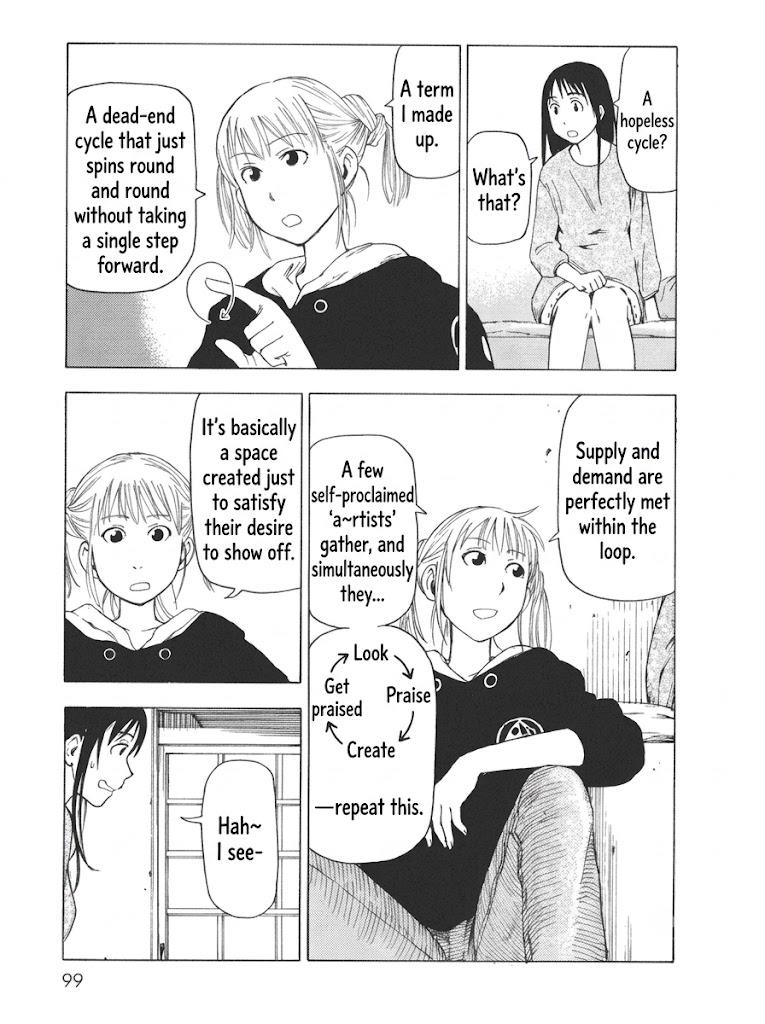
What makes this "Hopeless Cycle(no-answer cycle)" alarming is not that those involved act with malicious intent. It is a survival strategy born out of extreme self-esteem deficiency.
Creative work is inherently painful. You must confront your own inadequacy and endure the world's indifference. For those who cannot bear that pain, "praising each other" functions as a kind of painkiller. The term was originally a neologism mocking those who do not so much create work as use it as a pretext to maintain the identity of "being an artist."
On top of that, this cycle becomes progressively more entrenched: people who were once satisfied with a simple "nice drawing" eventually demand ever more extreme praise and validation. The more closed off the group becomes, the further their standards drift from the general public, and they ultimately end up trapped in a glass prison of their own making, cut off from society.
This term actually originated in comics and online communities as a way to satirize creative communities, but in truth it describes a phenomenon that appears in the vast majority of communities.
Realistically speaking, every group community carries this problem. The mutual praise and "I found this so inspiring" posts characteristic of LinkedIn, and the citation cartel culture in academia, are both examples. Even gaming communities exhibit the same issue.
Hacker News, open source, every place I have visited had some version of this culture. There was nowhere in the world free of it.
So does that mean every self-reinforcing cycle is harmful?
Probably not.
Imagine researchers in some academic field spending years building on the same foundational theory. If that theory holds up under repeated experimentation, predicts new phenomena, and resolves problems that previously had no explanation, then the continued citation of that established theory is actually a positive thing.
The same applies to creative communities. There are people who steadily produce work while praising and encouraging each other. If their goal is simply to enjoy their own creative activity, there is no particular reason they need to seek professional evaluation.
In fact, if researchers were to publish entirely new theories every time and discard all prior ones, stable accumulation of knowledge might become difficult even with less circular citation.
As is always the case, what is the hardest part of any line of criticism? It is that we inevitably account for extreme scenarios to some degree, assuming and critiquing conditions where the drawbacks of every community's characteristics are maximized.
The space where self-proclaimed artists gather to feed their need for self-display is, paradoxically, an excellent initial source of momentum that keeps them engaging in the painful act of creation, however weakly. The early salons took exactly this form.
What gets criticized as academia's citation cartel, and LinkedIn's exaggerated mutual praise, are also defense mechanisms that humans have devised for immediate psychological survival and the temporary accumulation of fragmented knowledge. If every researcher were to shatter existing paradigms every single time and pursue only perfect truth from the ashes, scholarship and technology could never accumulate to the next stage. A certain degree of stable self-deception serves as the lubricant that keeps the system running.
In fact, if such a community grows large enough, its members may fall under the illusion that recognition from within alone is sufficient reward, and that recognition alone may start to function like external stimulus. I am not sure exactly what size counts as "large enough to function that way," but organizations that have crossed national borders and grown sufficiently large do seem to have self-correcting mechanisms in their recognition and governance that look like genuine self-regulation.
Here we also encounter the paradox of scale. A cycle that, when the community is small, amounts to nothing more than a clique of "self-proclaimed artists" playing among themselves can, the moment it crosses a critical threshold in size, become "one enormous market."
Academia's vast citation cartels and LinkedIn's sprawling self-improvement discourse become authorities in their own right. Recognition from within becomes sufficient reward on its own, and that reward draws in outsiders. At that point, the cycle is no longer a closed loop but transforms into a "large-scale circular structure" that constantly interacts with the external world.
The term "Hopeless Cycle" originally mocked a negative trait of certain communities, but to my eyes the phenomenon is not unique to any particular group of people. Every community has the tendency to validate its members and reinforce its own standards. In some environments that becomes the force that sustains creative activity; in others it becomes a closed cycle that blocks external criticism. When a community grows large enough, that recognition converts into prestige and economic reward as well.
Ultimately, what I see as the Hopeless cycle is less an exceptional flaw confined to some specific community and more an inherent property of all communities that surfaces under certain conditions.
In other words, the Hopeless cycle is easy to criticize when it is small, because its standards are so detached from the wider world that it appears self-gratifying. But when that cycle grows into the collective knowledge of all humanity (Wikipedia) or a massive industry (the open source ecosystem), we no longer call it "Hopeless." We simply call it a "paradigm."
As an example, there are internal problems observable in Korean Wikipedia: certain articles can be effectively owned by specific editors, and flawed arbitrators may exist. Open source projects, too, once they grow large enough and become entangled with sponsorship, develop internal power structures and hierarchies. Yet simply being associated with such a project confers social recognition.
And that paradigm solidifies further, making it harder and harder to break.
Sometimes the mere fact that a group is sufficiently large itself becomes a reward for its members, and in pursuit of that reward people may in turn reinforce the group's evaluative standards even more.
So the Hopeless cycle may not simply disappear as it scales up. In a small group, internal praise remains a psychological reward; in a large group, internal recognition is converted into actual social capital.
If anything, the larger it grows, the harder it may become to distinguish the Hopeless cycle from a legitimate institution.
When a group grows larger, its evaluations do not necessarily become more accurate; rather, there may simply be more social reasons to accept those evaluations.
So what, then, is the Hopeless cycle? My sense is that it is probably a kind of early symptom of the closed loop that any creative community can develop. That symptom is always latent inside every community. The only difference is whether the pathological phenomenon grows or shrinks depending on the particular period.
A small Hopelesscycle avoids external evaluation, but a large enough Hopeless cycle can actually determine what counts as external evaluation.
When a community grows large enough, the problem is not so much resolved as it is that more and more people come to see it not as a problem but as self-reinforcement.
Speaking from the limited perspective of a short life, every group carries some degree of problems. In any group, strengths and weaknesses coexist. Some strengths become weaknesses, some weaknesses become strengths, and different aspects emerge depending on the situation.
Whether you evaluate a group generously or harshly simply depends on whether it is a group you happen to like or dislike.
How utterly emotional a creature the human being is.