
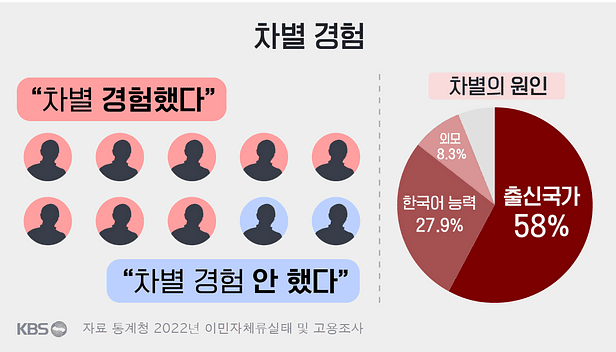
Why do so many people believe there is 'no racial discrimination' in Korea?
Korea has significant racial discrimination, and I say this as a Korean who has felt it firsthand.
"Korea doesn't beat up Black people the way America does."
"We've never legally segregated white people from Black people."
"Disliking Chinese people isn't racial discrimination — it's just disliking China."
"Joseonjok are the same ethnic group as us, so how could that possibly be racial discrimination?"
I actually think these reactions themselves are an important clue to understanding Korea's problem with racial discrimination.
In Korea, the word "racial discrimination" is used far too narrowly. There is a tendency to think that discrimination only counts when someone physically assaults a person of a different skin color, bars them from entering a restaurant, or institutionally separates people as the Jim Crow laws did in the United States. Yet many people will casually infer an individual's personality, intelligence, hygiene, morality, and likelihood of criminal behavior purely based on national or ethnic origin, without ever recognizing that as discrimination.
During my graduate school years, there was a friend named Ubina or Ujora who would eat with me at a Korean buffet near the Sungkyunkwan University graduate school. The attitude the restaurant owner showed toward that friend, together with signs posted in the restaurant about starving African refugees, illustrates the kind of everyday discrimination that exists in Korea.
Racial discrimination in Korea does not have to look the same as racial discrimination in the United States
When Koreans think of racial discrimination, the first society that comes to mind is the United States.
Slavery, racial segregation, the KKK, police violence against Black people — that history.
Those things are, of course, racial discrimination.
But treating only the forms that appeared in American history as the standard for what counts as racial discrimination leaves people unable to examine their own discriminatory behavior.
In Korea, even when someone demeans Chinese people or Joseonjok solely on the basis of nationality and origin,
"We're all East Asian, so how can it be racial discrimination?"
is what gets said. Attacks on Chinese people on the Korean internet have gone well beyond any reasonable limit.
I have seen this exact debate play out in comment sections myself. Arguments appear claiming that hating a specific nationality is not racial discrimination, and responses emerge insisting that discrimination cannot exist between people of the same racial group.
Of course, if we get into rigorous social-science terminology, not every form of nationality-based hatred can be captured by the single word racism. It is worth distinguishing racial discrimination, ethnic discrimination, xenophobia, and religious discrimination. But are the phenomena we encounter in everyday life really that neatly separated?
We look at someone's face and skin color and guess which country they come from.
Once we know their nationality, we guess their income level and occupation.
Once we know their ethnicity, we guess their crime rate, hygiene level, and personality.
And then we apply the group image we have constructed to the individual standing in front of us.
In one move, race, ethnicity, nationality, and class are all inferred at once.
The problem with Korea is that its racial discrimination takes a different form from that of the United States.
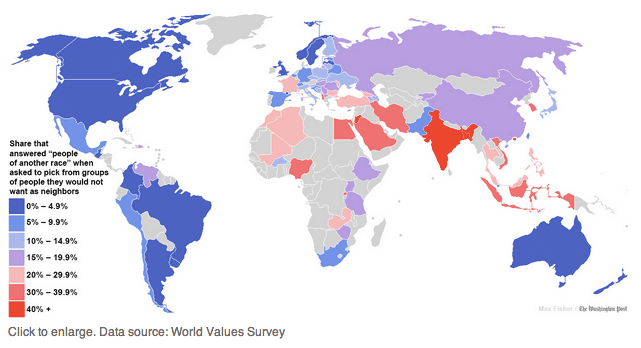
In Korea, nationality sometimes functions like a social class
Let's try a thought experiment.
Suppose there are two foreigners who are equally unable to speak Korean.
One is American; the other is a migrant worker from a poor developing country.
Would we really look at both people the same way?
Even among East Asians, do a Japanese tourist and a factory worker from Southeast Asia carry the same social image?
Does a high-earning engineer at a major Chinese corporation get treated the same as a Joseonjok construction worker, simply because both are "of Chinese origin"?
Probably not.
That is why explaining discrimination in Korea through skin color alone falls short.
I think the following framing is more accurate.
A hierarchy formed by the intersection of race, nationality, income, occupation, and ethnic image.
Some of the role that the category of race played in the United States is shared in Korea among nationality, ethnicity, and economic status together.
So being white does not automatically guarantee equal treatment, and being a fellow East Asian does not make discrimination disappear.
Disliking a government and disliking its people are different things
This issue becomes especially stark when the subject is China.
There are plenty of reasons to criticize the Chinese government.
One can criticize the policies of the Chinese Communist Party, or strongly oppose China's foreign policy and its human rights record.
One can criticize the Japanese government's understanding of history.
One can criticize certain Islamic religious norms.
One can oppose refugee policy. None of these is, in itself, racial discrimination.
But things usually shift in the following direction.
I dislike the Chinese government. Therefore I dislike Chinese people. Therefore it is acceptable to insult a Chinese person I have never met.
The state and the individual collapse into one.
What that person actually thinks does not matter.
Whether they support or oppose their government does not matter.
Just as a person born in Korea did not choose Korea as their birthplace, that person also did not choose to be born in China.
Yet based solely on nationality, an individual is held responsible for the actions of an entire state.
This is where I consider it discrimination.
Criticizing a government and its institutions is a different act from insulting an individual because of where they were born.
"So are you saying we have to like them?"
Whenever this topic comes up, there is almost always one predictable response.
"So you're saying we should like Chinese people?"
When someone said "So we have to like them?", another person shot back, "Is loving them the only alternative to hating them?"
I was dumbfounded.
Why do we think there are only two options?
Like ↔ Hate
Is there nothing in between?
You can simply not like someone.
You can be indifferent.
You can oppose a policy while feeling nothing toward the individual.
You can dislike a specific person based on their own behavior.
You can live perfectly well without feeling affection for any ethnic group as a whole.
Telling someone not to discriminate is not a demand to love others.
It means not putting an individual on trial based solely on the group they belong to before you know anything else about them.
That is all.
In Korea, hatred with a 'reason' easily becomes a free pass
People who discriminate typically do not believe they hate others for no reason.
There is always a reason.
High crime rates.
Bad manners.
Historical wrongs done to us.
Problems they have caused in our country.
A religion we dislike.
Being a burden on society.
Every form of hatred comes with a reason the person holding it considers rational.
It is rare for someone with racist views to describe them this way:
I hate that race for no reason at all.
Most believe they have sufficient grounds.
Using statistics or experiences about a group to judge the individual in front of you is an entirely different matter.
The fact that a country has a high crime rate does not mean the first person you meet from that country is a criminal.
Having had experiences with poorly-mannered tourists from a certain group does not give you the right to hurl insults at the next individual from that group you encounter.
Evaluating a country or a group and evaluating an individual are judgments that operate on entirely different levels.
I was once scammed in Daegu, and after reporting corruption in my university's student council I spent my remaining years there as a thorough outsider. Does that make Daegu a city of swindlers? Of course not. It only means that certain things existed within that particular group and that particular sample.
In Korea, it is easy to assume that without physical violence there is no discrimination
Still, at least we don't beat people up in the streets the way they do abroad.
This is an argument that comes up often in Korea.
Of course, physical violence is far more severe than verbal insult.
Discriminatory language and murder or assault must not be placed on the same level.
Korea's high level of public safety is also a genuine advantage.
However:
Not assaulting someone
and
not discriminating against someone
are not the same statement at all.
Service can be provided differently.
Someone can be excluded from consideration as a friend or romantic partner solely on the basis of their origin.
Mocking a person online because of their nationality is itself discrimination.
Someone can be insulted to their face on the assumption that they won't understand the language.
If the minimum threshold for deciding whether discrimination exists is "was the person physically beaten?", then milder forms of discrimination cease to count as discrimination at all. But the everyday discrimination that foreigners actually experience runs quietly and pervasively beneath the surface.
The old self-image of a homogeneous nation
Korea has long described itself as a homogeneous nation-state.
Korean society has imagined itself that way.
Foreigners have been regarded less as an ordinary category of community members and more as temporary visitors from outside.
Korea has not experienced prolonged large-scale immigration the way Western Europe or the United States has.
As a result, Korea appears to have had relatively little experience with racial conflict.
But there is a paradox here.
The absence of conflict does not necessarily mean a high degree of tolerance.
It may simply be that there were few opportunities to actually encounter people of other races and ethnicities as neighbors.
When they become a friend in your classroom,
a colleague at your workplace,
a resident in the same apartment building,
or a potential spouse for your child, the abstract image of "foreigner" begins to collide with a real individual person.
On top of that, since I am a programmer who tends to follow the gaming world, I have noticed an irrational and almost fanatical overheating around political correctness in particular.
Starting with the recent debate over Insomniac's Wolverine character design, everything perceived as bad gets labeled as PC, and an enormous amount of distortion and fearmongering is woven into that framing.
One reason political correctness draws such intense hostility on the Korean internet, I think, is that Koreans have long lived domestically as an overwhelmingly dominant ethnic majority. The culture of the majority does not feel like a culture at all; it feels like "common sense" or the default setting. So when minority groups ask that existing language or customs be changed, that request is easily read not as an effort to reduce discrimination, but as a restriction on the majority's freedom or a special privilege granted to minorities.
Korea in particular is not a society, unlike the United States, where conflicts between racial minorities and the majority have been at the center of social and political life for a long time. As a result, only the outcomes of political correctness, which emerged through the history of the civil rights movement and minority politics in the United States, have been imported, while the context explaining why those norms developed has not been adequately shared. So on the Korean internet, PC is often interpreted not as a norm by which minorities demand equal standing with the majority, but as a political movement in which minorities demand concessions from the mainstream.
So when minorities ask for changes to existing language and customs, it easily looks not like a reduction in discrimination but like "imposing new rules on ordinary people." This perception only intensifies when only the end-product norms of a long history of civil rights struggle and minority politics in the United States are imported into Korea without the accompanying context.
As a result, political correctness in Korea is often translated not as a norm by which minorities demand the same standing as the majority, but as a political movement in which minorities force concessions from the majority.
That is why many people have no interest in, and are openly hostile toward, the human rights struggles of those groups. The concept Americans call whiteness, the identity of the dominant group that is so pervasive it goes unrecognized as an identity at all, means that anything touching on minority groups even slightly gets received as an attack.
It is hard to say that extreme political correctness does not exist, but watching the extreme anti-PC overreaction in Korean gaming communities makes that dynamic especially clear. To put it precisely, what is happening is this: anything I personally find bad gets blamed on PC having ruined it. How absurd that is.
Racial discrimination always looks like the behavior of a distant villain
People dislike thinking of themselves as villains.
So when they hear the words "racial discrimination," they always picture someone far more extreme than themselves.
The KKK.
Neo-Nazis.
People who physically assault Black people.
People who throw foreigners out of restaurants.
Compared to them, I am a normal person.
Therefore, lumping all Chinese people together and insulting them is not racial discrimination.
Talking about Joseonjok as though they are inherently high-risk criminals is not racial discrimination either.
Assuming upfront that Southeast Asian people are poor and uneducated is also said to be not racial discrimination.
But by this logic, the racist is always someone else, slightly more extreme, never oneself.
And with that definition in place, almost no one ever needs to examine themselves.
Nothing counts as racial discrimination as long as there is no violence.
How absurd.
The discrimination and hostility toward Chinese people that is rampant on the Korean internet is disgusting.
The slur "착짱죽짱" — meaning "a good Chinese is a dead Chinese" — is disgusting.
There are far too many comments about Black people that demean them with phrases like "that race."
The YouTube comments attacking Indian people also irritate me.
Idolizing white Westerners and celebrating their culture, while turning aggression toward non-white people from countries with less power than Korea — that is Korea's ugly naked truth.
The Christians in Daegu who held rallies against 500 Yemeni refugees and protested against a lawfully permitted Islamic mosque are also disgusting. People who follow a religion that says to love your neighbor are holding demonstrations to drive other people out.
When I read the Korean internet, where people claim there is no racial discrimination in Korea while casually throwing around memes like the hoodie stereotype and slurs about "that race," I feel nothing but deep shame that I belong to the same people.