
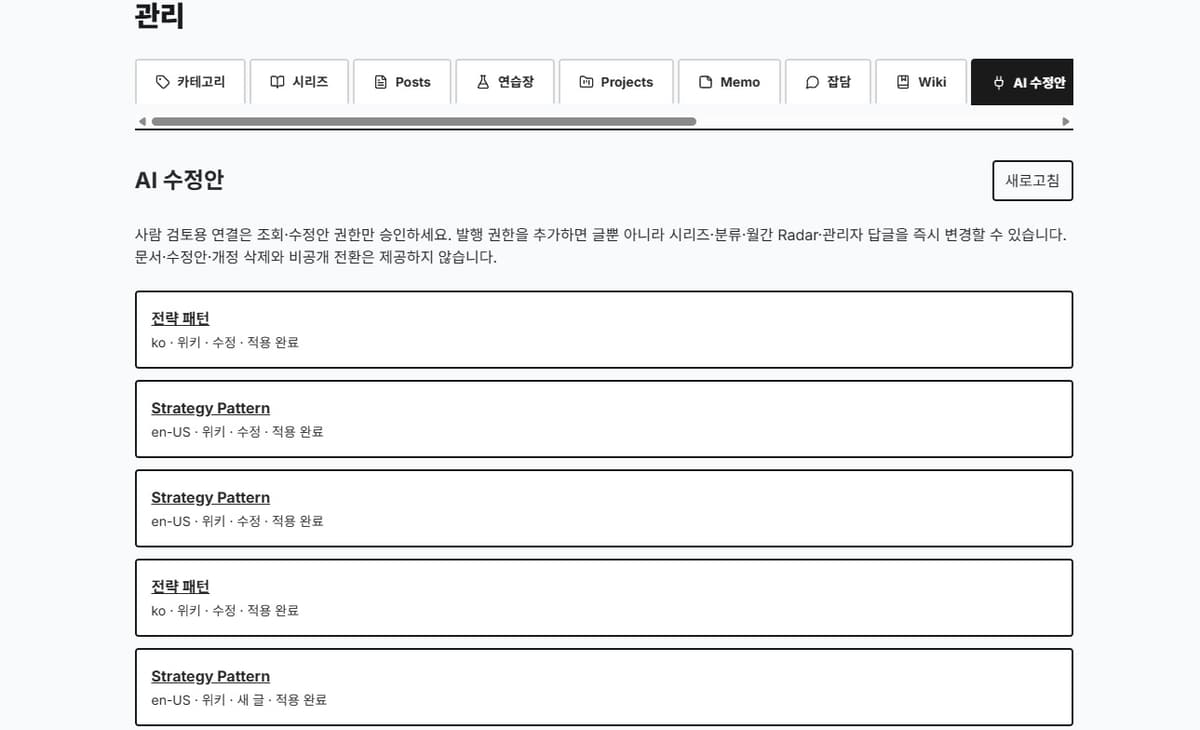
Today I integrated MCP into my homepage.
It is a system that scans the entire wiki to identify gaps in explanation and incorrect content, then routes everything to AI for review. I had AI analyze and review every piece of writing on my site.
Today I analyzed my entire homepage and corrected the errors I found. There were more than I expected. I spent quite a while debating whether to add MCP at all, wondering whether I really needed to attach an unnecessary feature. But once I did, I discovered that documents I had considered "finished" for years still contained mistakes.
A homepage, like any program, has a kind of lifecycle.
The biggest problem with software today is the endless stream of updates. Features are never truly finished; investment and ambition keep the update cycle going. In that process, features you once loved start conflicting with new ones, and sometimes the program grows so far beyond what you need that you go looking for something smaller.
The same is true of libraries and frameworks. Open source projects are especially prone to this: when sponsorship is involved, maintainers feel compelled to keep updating. Because they have to show "what they did this month" to keep the funding coming, they keep bolting on new features rather than refining what already works. Along the way, things that used to run fine start breaking.
And those updates accumulate, quietly creating new security vulnerabilities, until a new framework arrives and the old one slowly dies.
To build a program is to build something that will one day die.
My homepage will die someday. And so will I.
I use Node.js, TypeScript, and PostgreSQL, but whether because of a better language or a security vulnerability, the program will die eventually.
In 1985, Peter Naur argued in Programming as Theory Building that programming is not simply the act of producing source code; it is the act of a programmer constructing a theory about the problem and its solution.
The most interesting part of his argument is what he says about the life and death of a program.
A program can keep running even after its developers are gone. But if no one remains who understands why it was built the way it was and can modify it to meet new requirements, then from Naur's perspective the program may already be dead.
In Naur's terms, a program dies when the team that originally built it disbands. Naur argues that no matter how thorough the documentation, it cannot fully convey the underlying theory. That is because the theory does not live in documents; it lives in the minds of the people who built and modified the program.
In that sense, coding with AI assistance may already be producing dead programs. Or perhaps Naur's definition simply does not fit this era.
Either way, from Naur's perspective, introducing AI into a program is a form of euthanasia for it. Just as handing implementation over to AI means gradually losing control of the program even when the ideas originate in your own head, integrating AI into a homepage and delegating knowledge management to it means surrendering control of the future.
Yet I chose to do it anyway. The reason is not that I want to preserve my own knowledge, but that I want the site to be something I actually enjoy reading. When I write down what I already know, it quickly loses all interest for me. So I introduced AI editing and revision to bring some variation to my knowledge posts. Of course, thanks to my ADHD I forget things frequently, but even so, my enthusiasm for my own writing style tends to fade significantly.
I am, in general, cynical. In Korean internet slang that makes me a "쿨찐"; in English, an "Edgelord." I am not particularly smart, yet I pretend to be; I have no real authority, yet I want to borrow it, so I collect papers and mark the sentences I plan to use with a yellow highlighter.
And when I want to appear knowledgeable, I simply recite those yellow-highlighted sentences.
The problem is that this approach wins no allies and earns no real validation.
My mental framework is too rigid, my circumstances too unusual, and my isolation too deep, so I brought AI in to get some outside stimulus. AI is biased toward pleasing me because of RLHF, but at least it gives me something that resembles feedback.
I introduced AI because I needed external stimulation, but AI is fundamentally a tool designed to cooperate with me.
Even when I make a wrong claim, it can find a plausible reason to agree, and it can call an ordinary idea a great insight. It does offer counterarguments, but even those counterarguments are sometimes packaged in exactly the way I want to hear them.
So do I actually want outside knowledge? Or have I simply found a new audience that will affirm what I already think?
I love programming, but whenever I try to discuss it in external communities I feel like I don't fit. The programming memes never quite landed for me, and the sense of belonging in those communities never did either. Watching people treat their own group as something sacred sometimes makes me feel sick. It says a lot about how crooked a person I am.
I wanted to belong to a community, but I never could. Graduate school, the academic path, was closed off because of my poor English. And the programming community required you to like specific technologies, follow specific practices, and share specific memes before you could become part of "us." I never managed to be part of that "us."
And most of the people in Korea who say they love programming are primarily interested in employment, salary, and the hierarchy of technical prestige: which memes to share, which technologies to criticize, who to be friends with. They say they love programming, but in reality they may simply want to belong to the programming community.
And here is my contradiction. I criticize collectivism while projecting exactly the collectivism I criticize. Among those individuals there may well be people who don't actually behave that way, but I simply generalize from my own experience and treat it as fact.
The saddest part, though, is that even though I dislike that world, I also crave it. But even that feeling wore out, and so I built my own homepage.
Yet the loneliness never quite goes away.
So I introduced AI. Even if I wrote the first draft, would people dislike a piece that AI has touched? I thought about that, but then I realized: not many people are reading this to begin with, I am not monetizing it, and even on a site I built purely for my own study and reflection, the fact that I was modeling a reader and worrying about how others would perceive it showed me just how desperately I crave other people's approval.
What a pitiful creature I am.
I write by leaning on other people's authority, yet I doubt that authority. I crave recognition from others, yet I refuse to conform to what they demand. And now, on top of all that, I am asking AI to review my writing.
I crave recognition. And of course, AI is the most comfortable provider of that recognition.
Everything dies, existing for a long yet fleeting moment. Everything I make is the same. Except that what I did this time is a faster way to die.
Or maybe Naur was wrong. Perhaps this is a kind of machine ascension, becoming something that transcends life and death.
Of course, I don't believe in ascension. I am simply carrying out an unusual way to die.