

(Sakuraba Haruka from Cutie Street is absolutely beautiful)
How Trivial Is Inner Beauty
This is something a well-known private tutoring instructor once said in Korea, a phrase that became something of a cultural catchphrase.
Looking at Cha Eun-woo, a famously handsome celebrity, Mega Study instructor Jo Jeong-sik said it.
In psychology, this is called the Halo Effect, a reflection of just how visual and instinct-driven human beings are. People everywhere say in unison that inner character matters more than looks. We are taught that a truly good person is one who lives with kindness, honesty, consideration for others, and a sense of responsibility.
Yet the more one learns about how the world actually works, the more doubt creeps in.
Does inner beauty, in modern society, have any real economic value? Does living with a kind and virtuous heart genuinely help with survival and social success in the real world?
An Era When Goodness Was an Asset
Consider the old agrarian society, where mobility was limited and people spent their entire lives seeing the same faces. We don't even need to go as far back as the Joseon Dynasty. When I was growing up in the 1990s, there were still traces of communal life where the Kim family next door and the Lee family across the street all shared meals and raised children together.
In that narrow world, reputation was a survival asset. If you borrowed money from someone and skipped out on repayment, or swindled a neighbor, you were socially buried in that community. The structure was such that a shameful act today would immediately block tomorrow's transactions and relationships.
Conversely, earning a reputation for honesty and reliability opened up more work and opportunities for cooperation. I don't think people back then lived virtuously because they were inherently more morally upright. Rather, it was because, in the long run, living decently was simply in their own interest.
Game theory explains this through the concept of the Repeated Game. In a one-shot Prisoner's Dilemma, defecting is always the dominant choice, but when you have to keep playing the same opponent tomorrow and the day after, the calculus changes entirely. The long-term value of sustained cooperation far outweighs whatever small gain you pocket from a single betrayal.
Of course, what passed for reputation back then was, on closer inspection, probably less about genuine inner beauty and more about how compliantly one conformed to village norms. There must have been plenty of hypocrites who harbored different thoughts inside while performing kindness on the outside. But at least one thing was clear: in a world where you kept encountering the same people and rumors circulated endlessly, your actions accumulated as a record, and today's choices came back to you as tomorrow's bill.
People You Never Have to See Again
Modern society has completely rewritten the rules of the game. We can move, change jobs, and flip the table whenever we please.
Online, it gets even more absurd. If someone disagrees with you, one tap of the block button ends it. If you stir up trouble in a community and get called out, you just create a new account or migrate to a different community, and if a relationship becomes awkward, you simply ghost. The cost of exiting a relationship has approached zero.
If you never have to see the other person again, the dirty thing you did today will never come back to haunt you tomorrow. In this sense, the economic incentive to remain good simply evaporates. In a one-shot transaction, if you can hide a damaging flaw without being caught, the person who honestly discloses everything is the only fool. It is not that the moral value of goodness has disappeared; it is that the feedback loop through which goodness returned as personal benefit has been severed.
This is likely why inner beauty is increasingly devalued in modern society.
Inner Beauty Is Hard to Observe
When you first meet someone, their face registers in a second. Economic signals such as occupation, education, income, and the car they drove up in can be confirmed quickly with a few documents or a short conversation. In fact, a new term, "Rich Face," has recently emerged abroad to describe the phenomenon of wealthy individuals deliberately having their faces surgically altered in conspicuous, exaggerated ways.
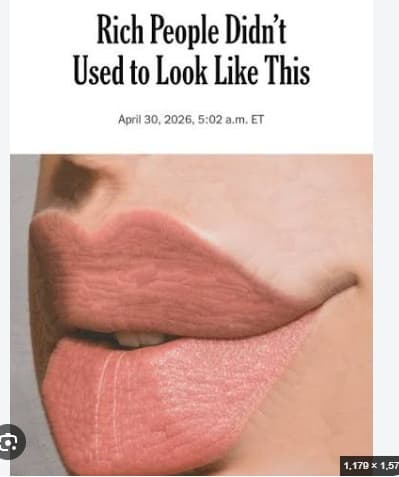
Beyond natural beauty, they are embedding directly into their skin the signal that they can afford to spend this much money on their face, flaunting it in an instant.1
But how on earth can you tell whether this person is someone who will stab you in the back at a critical moment, or someone capable of accepting personal loss without shirking responsibility?
Anyone can claim to be kind and honest. Every programmer talks as if they possess a craftsman's spirit. I don't buy that kind of talk.
Everyone writes "strong sense of responsibility" on their résumé, and that costs absolutely nothing.
A person's true inner character only reveals itself when they are cornered, or in a situation where they could get away with wrongdoing because nobody is watching. In other words, verifying someone's inner character requires paying the steep verification cost of "a long stretch of time" combined with "a crisis situation." Inner character is, in that sense, a long-term value.
But the environment modern people inhabit is not conducive to that.
Modern people simply lack the time and the luxury to observe others for that long. Because the window for evaluation is so short, people have no choice but to rely on the immediately visible surface: looks, credentials, wealth. Whether in romance or business, it is the same. The fact that someone turns out to be genuinely solid on closer acquaintance may sustain a relationship once it is underway, but it cannot serve as the key that opens the door to a relationship in the first place.
Here, inner beauty falls into a paradox.
It is a quality that shines brighter the longer a relationship lasts, yet the opportunity to begin that relationship is decided entirely by unrelated surfaces like appearance and credentials. No matter how golden one's inner character may be, if you are cut at the entrance, you never even get the chance to show it.
And you can hardly demand of others, "Invest your time and emotions in me until you recognize my beautiful inner self!"
Why Academic Credentials May Regain the Upper Hand in the Age of AI
Looking at the programming world, I feel the same paradox, and it is chilling.
There was always a credential barrier in the past, but at least in this field, a back door had been open through which you could prove your ability without a prestigious diploma.
If you brought a program you had written yourself, tracked down a bug nobody else could fix, and delivered a product that actually ran end-to-end, "Where did you go to school?" carried far less weight than "I built this."
Graduating from Seoul National University or Korea University didn't automatically mean you could write good production code. The theory learned at school and the craft demanded in the field were simply of a different texture.
People say it's good to have deep knowledge of algorithms, but honestly, in production work most developers reach for the highly optimized built-in structures and libraries that predecessors have already refined to the limit, rather than implementing data structures from scratch.
Far more often, half-baked knowledge led to premature optimization attempts that tangled the code and ruined maintainability. In the vast majority of application-layer work outside the narrow tier of top-tier Big Tech core development (FAANG and similar), what mattered far more than academic algorithms was maintainability tied directly to the software's lifecycle, what you might call Code Hygiene. And that was a wilderness skill that no university classroom ever taught.
Back then, a working deliverable was itself the evidence that you had survived that time in the wilderness. But as the era of AI writing code on your behalf arrived, the value of that evidence collapsed.
Now anyone who prompts well can knock together a polished-looking landing page or demo app in no time.
Granted, knowing how to work with AI is itself a skill. The problem is that when two candidates walk in with equally slick interfaces, there is no longer any way to tell from appearances alone which one has the Code Hygiene to rearchitect the codebase when requirements flip, and which one is simply incapable of cleaning up the mess the AI left behind.
Galdin and Silbert's 2025 study bears this out: on a freelancer platform (Freelancer.com), the tendency for clients to open their wallets in response to carefully tailored proposals had noticeably weakened after the advent of Large Language Models (LLMs). A well-crafted piece of writing is no longer a Signaling of diligence or competence, ushering in what the researchers call the era of "Making Talk Cheap."2
A hiring manager cannot spend months working alongside hundreds of applicants. When candidates are plentiful, evaluation time is scarce, and every portfolio looks equally impressive, what will the HR team ultimately lean on?
They fall back on the old markers that are easiest to verify and hardest to fake: academic pedigree and Big-Tech experience. Academic credentials do not tell the whole story. The point is simply that because the "working deliverable" signal that once let people prove ability outside elite institutions has been contaminated, it has become the safest and cheapest option to free-ride on the already-verified output of university admissions. (To be fair, a survey experiment by Stephany et al. in 2026 found that AI skills can partially offset the disadvantage of a weaker academic background, but that is ultimately just another combination of credentials written on a piece of paper.)3
Values that only reveal their worth through prolonged observation get eliminated before they even reach the starting line, precisely as the era of rapid filtering at the entrance intensifies.
How hollow is the optimism that releasing coding tools to everyone has somehow equalized opportunity.
The Market for Lemons and the Line Between Integrity and Naivety
Someone might push back: "If the world is that ruthless and riddled with con artists, shouldn't the genuinely honest and capable person become so rare as to command any price they name?"
Unfortunately, the law of the Market for Lemons, as described by economist George Akerlof, does not work that way.4
The seller knows whether the car is a pristine, accident-free gem or a flashy wreck (a lemon), but the buyer has no way of knowing even after opening the hood. When buyers cannot distinguish between good cars and bad ones, they end up lowballing every used car to below-average prices. The owners of genuinely good cars, unable to get fair value, leave the market, and only scammers and lemons remain.
In economics, this is called Adverse Selection.
Human relationships and the labor market work the same way. No matter how scarce genuinely honest people or developers who truly understand the fundamentals become, that scarcity translates into no reward whatsoever if the other party lacks the discernment to recognize it. And the resources available for that verification are limited.
Instead, distrust deepens: "Everyone is probably slapping together sloppy AI-generated work and lying about it," "Everyone is probably just looking out for themselves." This blanket suspicion ends up tainting even the genuinely solid people.
And in reality, people tend to overvalue themselves, which makes it all the harder to take anyone's self-assessment at face value.
But I use AI and I rigorously verified everything.
The one who caused the problem was a different developer; I was the one working as hard as I could to clean it up.
Statements like these contain some truth, but they are also exaggerated or simply inaccurate in part. It is much like how academic papers sometimes describe something done a handful of times as having been done "extensively" or "repeatedly."
People fundamentally tend to frame things in their own favor, which is ultimately why it is so hard to trust anyone's self-assessment.
A striking illustration of this is Robert Axelrod's computer tournament of iterated Prisoner's Dilemmas, where the ultimate winner was, surprisingly, the simplest strategy of all: Tit for Tat.5
The rules of this strategy are straightforward. In the very first round, you cooperate unconditionally (the good-faith move). But if your opponent stabs you in the back, you retaliate in kind without mercy in the next round, and when they return to cooperation, you cooperate again.
If you cannot verify another person's goodness upfront, you start with a small act of cooperation and observe their behavior through repeated interaction. And you must set boundaries so that your goodness is not exploited.
In the end, goodness need not be passive submission; it requires not only the capacity to trust others but equally the judgment to know when to withdraw that trust.
Perhaps what has become even more important in modern society is not goodness itself, but the ability to verify each other's goodness and convert it into sustained trust. Though, honestly, that probably seems nearly impossible to achieve in contemporary life.
Are We Spending Time to Truly Know Others?
In the end, the question I posed at the beginning comes back to me like a boomerang.
We all want others to be honest with us. We want our clients to recognize our true competence, and we want our partners to see our deeper selves. Yet when it comes to how we treat others, we pull out a calculator and ask, "What's in it for me to be a decent person?" Everyone wants to consume the goodness and sincerity of others, while nobody is willing to pay the cost of sustaining and uncovering it.
But society will increasingly drift toward short-term transactions rather than long-term commitments. In fact, it already has. We live in an era of information overproduction, one that has evolved to demand rapid interpretation of vast amounts of data. Information that requires long-term observation falls behind.
Extended verification is a cost; the surface visible at a glance is efficiency.
The more capital and technology advance, the more the world skips the work of uncovering the genuine thing that takes time to know, and instead reaches for answers by quickly scanning the plausible-looking fake that can be confirmed in a second.
AI-assisted work is no different. People prefer to click and get an instant answer from AI over reading documentation, building a mental model of programming, and learning through error logs and failure.
In the old days, crafting a good sentence meant spending roughly three days thinking before writing. Nowadays you run dozens of prompts through AI, take whichever output you like best, and splice them together.
And it costs far less. In the face of this overwhelming logic of efficiency, phrases like "inner beauty" and "craftsmanship" become anachronistic relics fit only for a museum.
The most darkly comic part of all this is me, the person writing these very words.
I have spent this entire post pouring out cynicism about a world that only sees surfaces, yet at the very top of the article I placed a photo of Sakuraba Haruka. I, too, have no desire to go to the trouble of peering into someone's deep and tedious inner life. Looking at something beautiful is simply better for my mental health.
How trivial is inner beauty.
The reason the instructor's joke stings is probably not that it is wrong, but that it is an uncomfortably accurate portrait of ourselves, one impossible to refute.
Footnotes
- An article satirizing the distorted plastic surgery practices of the wealthy (link) ↩
- Anais Galdin and Jesse Silbert, "Making Talk Cheap: Generative AI and Labor Market Signaling," 2025, arXiv preprint. Abstract and full-text link. What is cited in the main text is the change in employers' willingness to pay for application customization. The figures on hiring changes across higher- and lower-skill groups are results from counterfactual simulations using a structural model. ↩
- Fabian Stephany, Ole Teutloff, and Angelo Leone, "AI Skills Improve Job Prospects: Causal Evidence from a Hiring Experiment," revised 2026-03-04, version 2, arXiv preprint. Abstract and full-text link. This is a survey experiment in which 1,725 recruiters from the UK, the US, and Germany compared hypothetical résumés. ↩
- George A. Akerlof, "The Market for 'Lemons': Quality Uncertainty and the Market Mechanism," The Quarterly Journal of Economics 84(3), 488–500, 1970. Full text, bibliography, and DOI. The discussion of human relationships in the main text is presented as an analogy to information asymmetry. ↩
- Robert Axelrod, "More Effective Choice in the Prisoner's Dilemma," Journal of Conflict Resolution 24(3), 379–403, 1980. Publisher abstract and bibliography. Tit for Tat is a strategy that cooperates on the first move and then mirrors the opponent's most recent action in each subsequent move. Tournament performance does not prove optimality in all environments or moral justification. ↩