
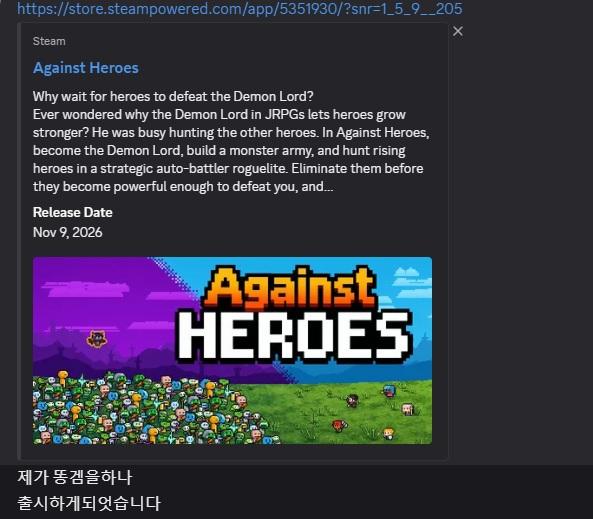

An acquaintance of mine released a game. Apparently it took just over a year to make, with no AI involved whatsoever.
Something worth celebrating.
I also went on a business trip today. Probably because everyone is talking about entering the AI era, I got a call from a logistics company about their WMS, with the small-business side apparently wanting to use AI to automate their Excel work.
There, the owner treated me to sundubu-jjigae, and I went through the company's Excel files to explain the gap between what the owner expected and what was actually feasible.
Small and mid-sized companies in Ulsan still tend to have somewhat outdated ERP systems and internal IT infrastructure.
Generally, they do small tasks in Excel and then submit those spreadsheets to Hyundai Motor as their quantity reports. Since younger workers have been leaving the factory areas, there's no one who knows how to handle Excel, and the companies can't afford to hire new people, so they said they want to reduce the burden on existing staff.
To paraphrase the owner's words, 'the people here have a lot of mileage on them,' so continuing to do all this work by hand is too grueling, and the question was whether AI could handle demand forecasting.
A standard WMS can generally handle logistics scheduling, but this case was unlike anything I'd seen before, so it turned out to be more of a tricky situation than I expected.
Many companies in Ulsan have no internal IT systems. The clients I mainly work with are either long-established companies that maintain everything in Excel because their workflows are outdated, or early-stage startups, and those are the two types I mostly deal with.
This case was different from a conventional vehicle-dispatch WMS, and I expected some differences going in, since even logistics companies don't all manage data the same way. Still, the actual workflow turned out to be nothing like what I had worked on before.
To start, we talked about pulling data from MSCP (Hyundai Mobis Supply Chain Portal) and mapping out the shipment planning. Ulsan is essentially a factory city, and most of the work here flows toward Hyundai Motor and SK. Hyundai Motor itself is reasonably well digitized, so its input and output data formats are standardized, but in this case the issue is that the sub-tier suppliers beneath Hyundai Motor lack adequate digitization. From that angle, the key question for the shipment-side automation is how far it can realistically go, and the final deliverable that matters is submitting the Excel data in the format Hyundai Mobis requires.
In other words, the input and output data are the same, but the internal workflow was completely different from any company I'd worked with before. That's the hardest part about being a programmer. Even practitioners often don't have a clear picture of their own workflow or exactly which parts of the work they'd like to reduce. They do their assigned tasks precisely, but articulating those tasks is a different skill, and observing them and automating them is my job. In this particular case, though, there are Excel files to work from, so the plan is to build a database from that Excel data, define the DTOs, and then split things into pages. I don't think it'll be excessively difficult.
Anyway, after talking things through, I showed them a rough estimate. I based it on Wishcat's standard rates and knocked off about 30%. They said they'd get back to me by next week, but honestly I'm not sure they're really motivated to move forward. Usually, people who genuinely want to proceed pin down the estimate and timeline quickly, whereas this time everything was left vague. I charged a 60,000 won travel fee and got a free meal, so I'm not complaining.
After that, I had a conversation with some acquaintances based in Seoul.
On my way home, I found myself thinking about a lot of things, starting with the question of how long I can keep doing this work.
Lately, pretty much all of my programmer friends are getting laid off. Even a friend who worked at a large company like NC said there's no work. I'm managing to keep myself afloat for now, and I have work experience with companies in the US, China, and Japan, so I do have some confidence that I can survive no matter what, but I honestly don't know how long I can hold out in this situation.
Every time I try to browse Korean programming sites for information, everyone there is on edge because the job market is so bad right now, and it's hard to get useful information out of those spaces, so I've started avoiding them.
That said, thinking about where my programmer acquaintances stand, maybe I'm the one who has it good. One of them told me it's painful living as a lower-class person in Seoul.
'Lower-class in Seoul' — does that make me lower-class in Ulsan, then? That thought crossed my mind, but I think I understand what they meant. The moment you quit your job, you can no longer afford Seoul rent and effectively have to leave the city, yet IT work barely exists outside Seoul, so people are hanging on for dear life.
I wrestled with the same dilemma five years ago. I ended up moving down to Ulsan, and I failed to get properly established. These days, a really large number of developers in that in-between career stage are getting let go. And yet, right in the middle of all that, the friend who got laid off still managed to ship a game. Meanwhile, I'm just treading water.
I need to ship something too, but what can I actually do? Every time, I tell myself I need to release something, yet when it comes down to it, I keep making excuses that small tasks are getting in the way, and it's starting to feel like just that: excuses.
The 3D tower defense game I was working on recently got put on hold because I couldn't find suitable assets, and now I'm wondering whether I should just use AI to generate sprites and build the game that way.
The reason I had bought assets in the first place was to earn the 'no AI used' label, since from a marketing standpoint it's far more beneficial to say you didn't use AI. If I'm going to use AI anyway, I'm thinking it makes more sense to restart the project entirely from scratch.
But as always, I end up doing a lot of thinking and not much else. Everyone says you can build anything with AI, yet here I am, using AI and somehow still having nothing to show for it.