
Why Is AI Writing Hard to Read?
Starting from next-token prediction and transfer learning, this essay traces how syntactically compressed phrasing turns into reading overhead for humans.

Hear the word 'cat', and what comes to mind first? For most people, something like 'cute' pops up almost effortlessly.
Large language models are usually explained in much the same way. They keep tacking on whichever next word fits best after the words that came before.
Stringing plausible words together is one thing, and writing a sentence a human can actually read comfortably is quite another. When you read an AI-written explanation, you may know every single word on the page yet still lose track of what modifies what or who is doing the action, so your eyes keep darting back up a line. It feels uncannily like a brutal standardized reading-comprehension passage. (Honestly, I sometimes think LLMs would outperform professors at writing entrance-exam questions, because both share an uncanny knack for twisting perfectly ordinary language into a knot.)
Let's pull an example from what Korean tech workers call 'Pangyo dialect' (the local nickname for bloated corporate-tech jargon). Nothing exposes this exact friction more bluntly.
“Initialized the application log archiving retention policy configuration interface.”
Take that sentence apart for a second. It sounds as if it describes a sprawling distributed system, yet none of the individual words is particularly obscure, and nothing breaks a rule of grammar. Even so, the meaning refuses to land on the first pass.
Why? Because nouns pile up one after another without a single relational marker between them. Are we archiving application logs, picking how long to keep them, or simply opening the screen where that setting lives? The reader has to rebuild every missing link by hand.
“Opened the screen that sets how long to keep application logs.”
If that was the actual point, spelling it out like this solves the problem immediately. The sentence barely gets any longer, yet what is being configured and what action happened come through in the exact order your eyes read them.
Of course, if a phrase is an official UI label or an API spec identifier, you cannot rename it on a whim, and when a team shares aligned context, that wording causes zero communication friction. Still, should onboarding documentation default to the same naming? When a new reader has to recover omitted context on their own and reverse-trace dependencies across layers, a gap opens between the intended insight and the actual reading experience; the text looks compact, while communication cost and cognitive load spike.
By now you probably felt it yourself.
If you just had to re-read that last paragraph to figure out what on earth I was saying, that is the whole point of this piece.
Here is the strange part, though. Humans reach for corporate jargon to sound impressive or dodge blame, so why does an AI pack sentences together the same way? Nobody sat down and trained it exclusively on buzzword decks.
What Comes After 'Cat'
To trace the cause, we have to go back to our 'cat' example.
Most modern language models are autoregressive: they build text from left to right, one step at a time. The mechanism is strikingly plain. Looking at the entire preceding context in the input window, the model scores every candidate that could come next, picks one, appends it to the end, and repeats the exact same calculation with that new piece included.1
What a model treats as a unit does not match what a person pictures in their head. We think of the word 'cute' following 'cat', whereas a model operates on tokens, so depending on how its tokenizer was built, a single word might stay whole or split into stems, suffixes, and subword chunks.
An ordered line of those tokens is called a sequence. In the conditional probability P(next token | prior context), what really steers the prediction sits behind the vertical bar: the entire prior context. The model is not glancing at the last word in isolation and guessing blindly.
The word right before the arrow is 'cat' in both rows. Yet the bottom sentence plants someone's fear right up front, and once the preceding sequence shifts that sharply, the probability distribution over what comes next flips upside down.
The architecture that weighs that entire prior context in one sweep is the Transformer.2
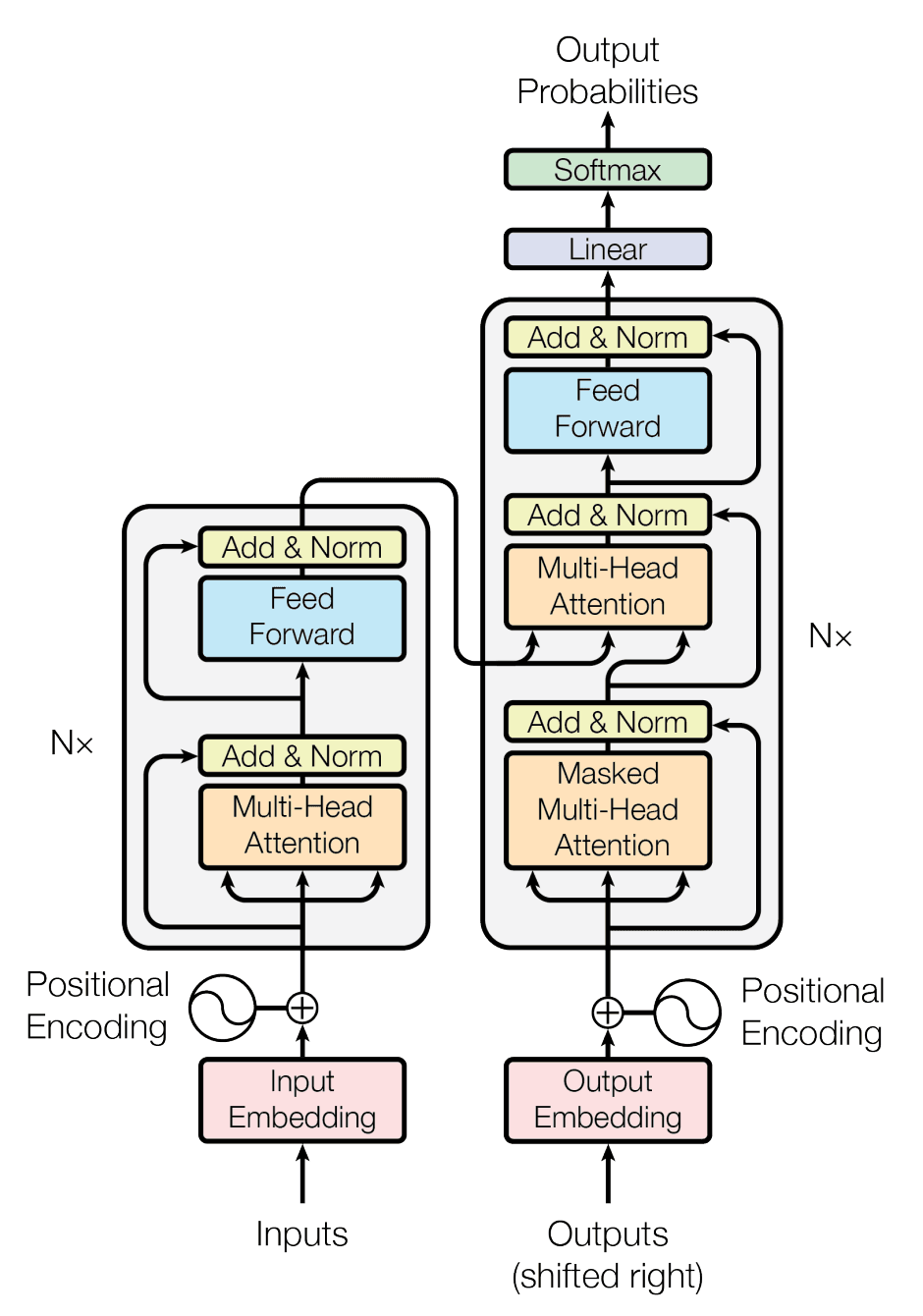
(Transformer architecture — Vaswani et al., 2017, Figure 1)
Introduced in the 2017 paper Attention Is All You Need, a Transformer converts tokens into numeric vectors and then uses attention layers to decide how much weight to place on each earlier position before blending them together. Masking hides future tokens that have not been generated yet, and feed-forward layers map the blended representation into a probability table for the next token.
Training Time Versus Answer Time
Where does that probability table come from in the first place? Pretraining builds it.
Pretraining chases one remarkably simple objective. Feed the model mountains of human-written text and nudge its weights (parameters) bit by bit so that whichever token actually came next gets a slightly higher probability.
Repeat that loop across trillions of tokens, and the model moves far past memorizing a single pair like 'cat → cute'. Descriptive vocabularies, syntactic habits linking subjects to predicates, and even a speaker's stance and cadence quietly settle into the same probability distribution.
The idea of stretching patterns learned in one sentence to brand-new word combinations already took shape in Bengio et al.'s 2003 paper A Neural Probabilistic Language Model.3
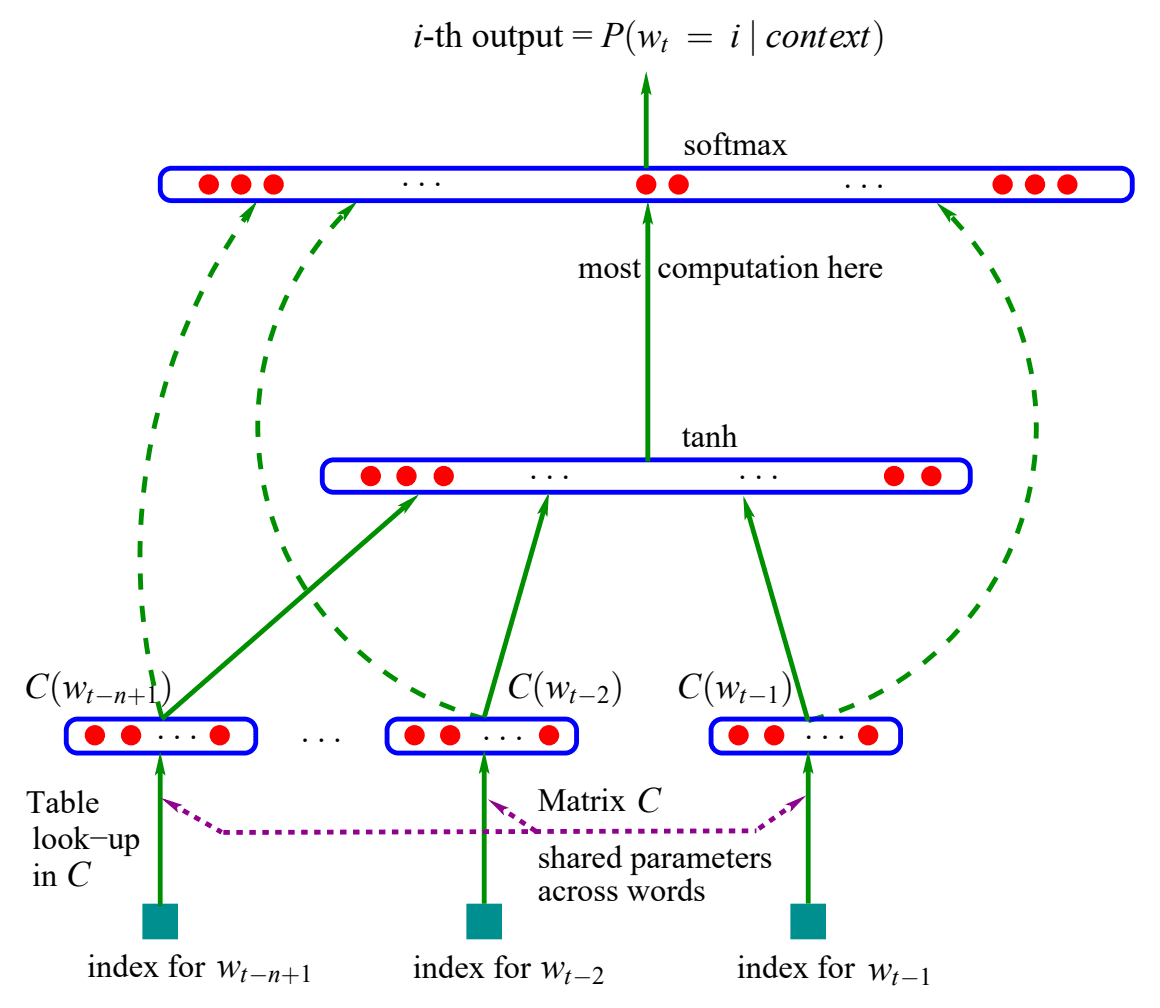
(Neural language model computing next-word probabilities via shared word-vector matrix C and a hidden layer — Bengio et al., 2003, Figure 1)
That model jointly trains a lookup table turning words into real-valued vectors (distributed representations) alongside a neural network predicting the next word. Even if the training set contains “The cat sleeps on the sofa” and never once contains “The dog sleeps on the floor,” placing 'cat' and 'dog' close together in vector space lets the network generalize smoothly to the unseen combination.
When we chat with a deployed model, those weights stay frozen. Give it 'cat → cute' and 'dog → playful' in the prompt and ask it to complete 'rabbit →', and it follows the pattern on the fly without changing a single parameter, a phenomenon highlighted in Brown et al.'s 2020 GPT-3 paper Language Models are Few-Shot Learners as in-context learning.4
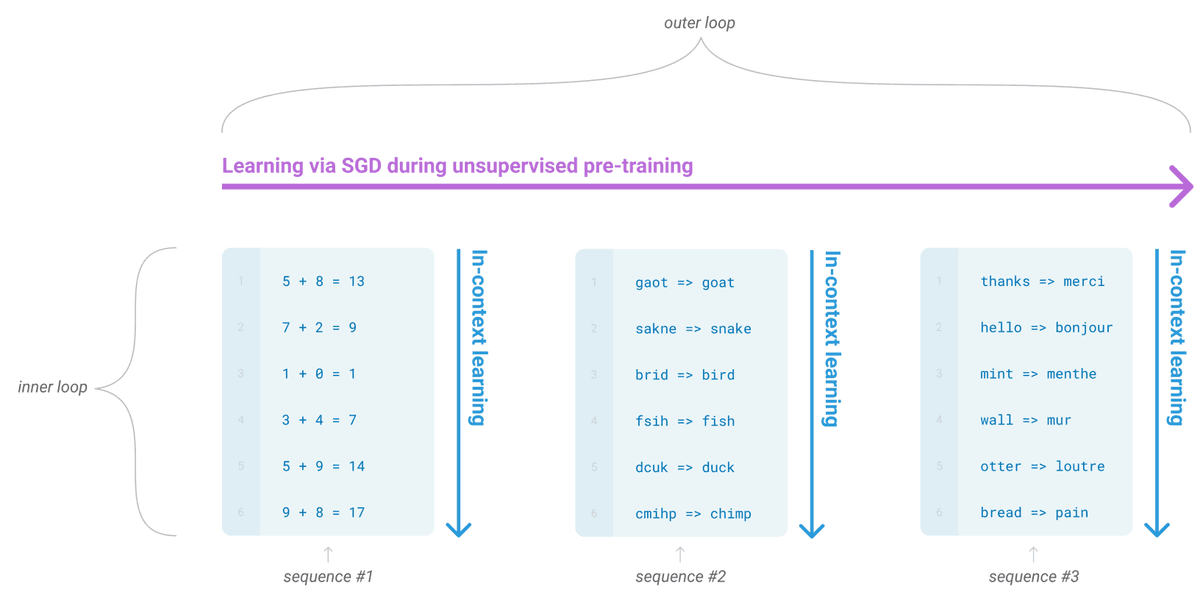
(Pretraining that updates weights versus in-context learning from prompt context alone — Brown et al., 2020, Figure 1.1)
Ultimately, only two forces shape how a model sounds: the prompt sitting in the input window right now, or habits already baked deep into its weights. If you ask an ordinary, unremarkable question and still get stiff, airless prose back every time, the prompt is rarely the culprit. You have to ask what habits got welded into the weights during training.
Pet Ads and Field Notes
One more concept completes the picture: transfer.5
Reusing knowledge or representations learned in one domain on a different task is called transfer. Radford et al.'s 2018 original GPT paper Improving Language Understanding by Generative Pre-Training established the classic blueprint: pretrain next-token prediction on huge piles of unlabeled text, then carry those exact weights over and fine-tune them on concrete tasks like question answering or textual entailment.6
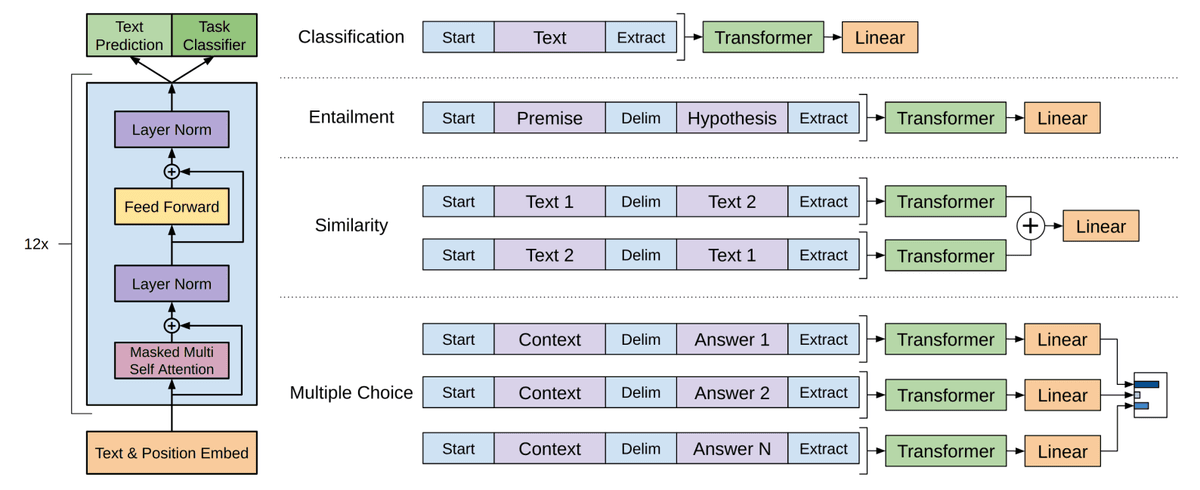
(Pretrained Transformer decoder and task-specific input sequence transformations — Radford et al., 2018, Figure 1)
Copying weights wholesale is not the only route. As Weiss et al.'s 2016 survey A survey of transfer learning summarizes, feature-based transfer aligns or maps the feature spaces of two domains directly so representations can be reused.7
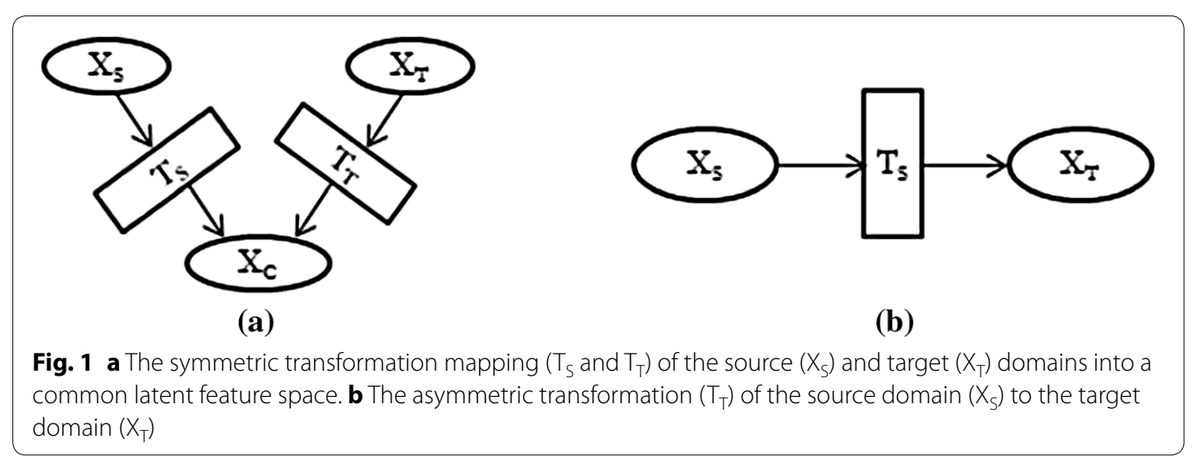
(Feature-based transfer linking two domains into a shared space or mapping one into the other — Weiss et al., 2016, Figure 1)
Habits imported from earlier training do not always help. When prior training beats a baseline trained without source data, that is positive transfer; when those old habits actually drag target performance below the baseline, you have negative transfer.8
Put in terms of our cat analogy, the contrast looks like this.
Carried over from prior training | Effect on the new task | Outcome |
|---|---|---|
Animal vocabulary and sentence patterns | Describes rabbit behavior more accurately on a brand-new task | Positive transfer |
Gushing praise and emotional copy from pet ads | Injects baseless impressions into a neutral behavioral log, hurting accuracy | Negative transfer |
- Carried over from prior training
Animal vocabulary and sentence patterns
- Effect on the new task
Describes rabbit behavior more accurately on a brand-new task
- Outcome
Positive transfer
- Carried over from prior training
Gushing praise and emotional copy from pet ads
- Effect on the new task
Injects baseless impressions into a neutral behavioral log, hurting accuracy
- Outcome
Negative transfer
What crosses from one task to another is not just word associations like 'cat → cute'. Syntactic habits travel right along with them: what sits at the front of a sentence, how many modifiers get stacked on top of one another, and how tightly an explanation is packed.
Just as gushing pet-adoption copy ruins a dry behavioral observation log, an information-compression habit that racked up points on one benchmark can cross over into everyday writing and leave human readers gasping for air.
The Missing Words Between Nouns
That exact mechanism is the focus of Clark et al.'s 2026 paper Why is AI-generated language so hard to understand?9
Earlier studies mostly tallied buzzwords like 'delve' or formulaic openings. Clark et al. asked why AI prose still feels sluggish even after you strip out every cliché, and measured six syntactic and lexical indicators that psycholinguistics links directly to human processing difficulty.
First is the Pangyo-dialect culprit from our opening: stacked noun compounds where three or more nouns chain together without prepositions or relational markers. Instead of spelling out which file is kept for how long, the sentence couples nouns like freight cars and hands the reader the job of figuring out where the parentheses go. Character count dips slightly, while the reader's mental parser stalls out rebuilding brackets.
Physical distance between linked words trips readers up too. When endless modifiers and asides wedge themselves between a subject and its verb (long dependency length), the reader has to hold that early subject in working memory across the whole detour.
Reduced object relative clauses do something remarkably similar in English, swapping a passive or full clause for a tighter active one while dropping 'that' or 'which' altogether. Saving one tiny word erases the signpost that told the reader where the subordinate clause began.
Verbs behave even more strangely. Nouns get pressed straight into service as verbs (denominal verbs), and active verbs that normally expect a living agent get bolted onto inanimate subjects, all layered with unattested bigrams that never appear in reference corpora and high trigram perplexity.
Actual model outputs from the paper make the habit obvious right away: compressing 'put it on the calendar' into 'calendar it', or writing 'this asymmetry bites' where a person would write 'this asymmetry causes trouble'. Tokens definitely drop, yet the reader pays the bill by unpacking a noun-turned-verb and translating an inanimate metaphor back into plain cause and effect.
The trouble is not that AI reaches for compression in poetry. The trouble is that it treats stripped-down, marker-free syntax as its default even in everyday chat, code walkthroughs, and essays where clarity should come first.
Round-Trip Translations and Human Prose
How pronounced is the pattern in practice? The researchers assembled 14 model configurations spanning nine frontier and near-frontier models plus five smaller open models (the Llama 3.1 8B and Olmo 3 7B families), then sampled text across three settings: everyday conversation (12 models), agentic coding (9 models), and persuasive essays (14 models).
They evaluated those outputs against two yardsticks. One was genuine human corpora: movie subtitles (OpenSubtitles), developer Q&A (StackExchange), and U.S. middle- and high-school essays (PERSUADE 2.0). The other was round-trip translation, passing AI-generated English through a translation model (NLLB-200) into Japanese and straight back into English.
A round trip through translation keeps the core meaning intact while untangling needlessly knotted syntax. So whenever a high-cost construction drops sharply after round-trip translation, it was never required to express the idea; the model simply chose a denser phrasing over a plainer alternative.
Once the numbers came back, the gap stood out sharply. Across all three settings, frontier models consistently produced more unattested bigrams, denominal verbs, inanimate-subject animate-verb pairings, and reduced object relative clauses without 'that' than their own round-trip translations. Conversely, they used full relative clauses with an explicit 'that' less often than the round-trip versions, stripping out optional function words wherever they could.
Long dependency lengths and stacked noun chains of three or more words also ran distinctly higher in raw outputs during multi-turn conversations and coding. Stacked directly against human essays, all nine frontier models leaned far more heavily on personified inanimate subjects and rare word pairings than student writers did.
The smoking gun appeared inside a single open model family when the authors compared three Olmo 3 7B checkpoints. The pretrained Base model and the standard Instruct model sat close to human student essays with small round-trip gaps, whereas Olmo Think, which underwent reasoning-focused post-training, surged to commercial frontier levels of dense syntactic compression.
Why does post-training alone make a model start folding its sentences so tightly?
The Model That Picked the Shorter Option
The authors point to a shift in the center of gravity of post-training. Earlier reinforcement learning from human feedback (RLHF) relied on human raters, who often rewarded longer, friendlier explanations.
Recent performance leaps, however, owe far more to reinforcement learning with verifiable rewards (RLVR) used for math, coding, and formal reasoning. There is no human reader in that loop. Automated graders only check whether the tests pass or the final math answer matches. Working inside finite context windows and token budgets, models face an 'information compression pressure' that rewards shedding function words and packing claims into fewer tokens.
To test that hypothesis directly, the authors ran a second experiment with Qwen2.5-1.5B-Instruct using GRPO to turn JSON event records into a single English sentence. Correct sentences covering every required field earned a reward, while a per-token length penalty (λ) docked points for each extra token so a shorter equivalent sentence always scored higher.10
Consider 'He sent us a photo' (6 tokens) versus 'He sent a photo to us' (7 tokens because of 'to'). Both carry the exact same meaning. Alongside this dative alternation, the authors trained on omitting 'that' in object relative clauses, omitting 'that' in verb complements, and a zero-token-difference control using particle-verb order ('picked up the book' versus 'picked the book up').
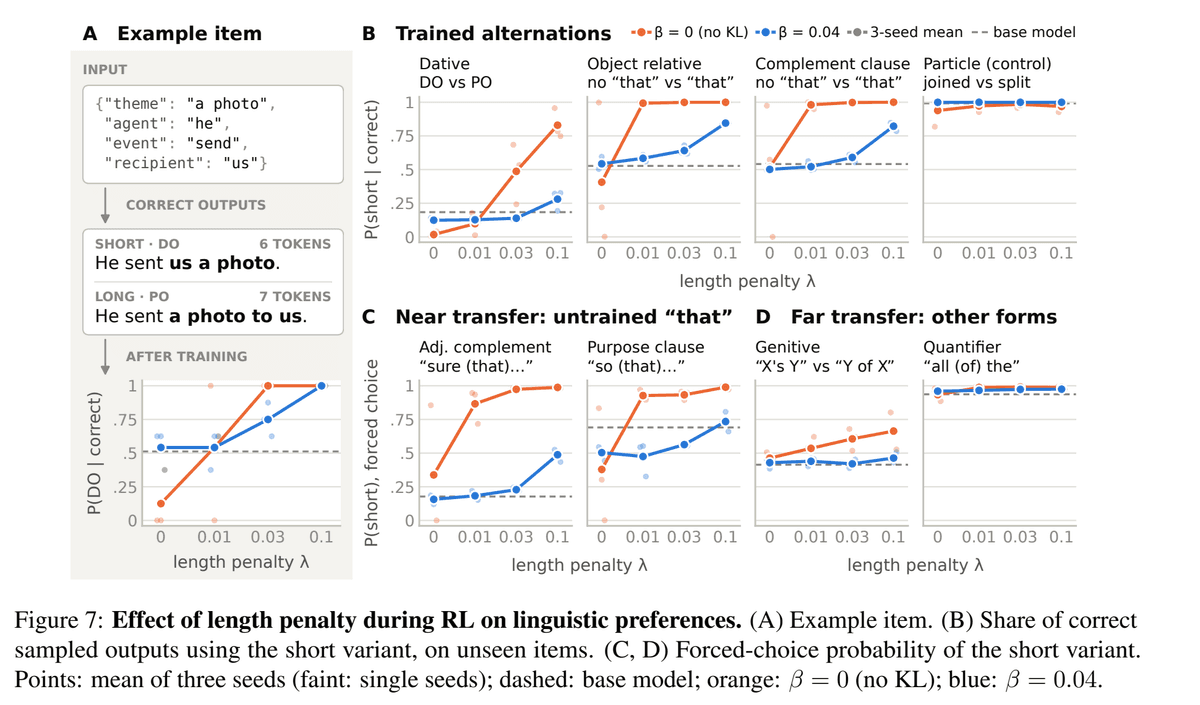
(Preference for shorter constructions under length penalty across trained, near-transfer, and far-transfer conditions — Clark et al., 2026, Figure 7)
Figure 7 lays out the outcome. Turning on the length penalty (λ) drove the model to pick the shorter form nearly 100% of the time across all three token-saving constructions, while leaving the zero-difference particle-verb control alone.
Panels 7C and 7D are even more telling. On adjective complements ('sure (that)') and purpose clauses ('so (that)') never seen during RL training, the model quietly began dropping 'that' on its own (near transfer). Once KL regularization (β) holding the model near its base distribution was switched off, it even shifted toward shorter possessives ('the old house's roof' over 'the roof of the old house'), a structurally distinct far transfer.
Nobody ever instructed the model to compress prose or delete relative pronouns. Simply rewarding shorter correct answers was enough to lock it into picking the clipped option across the board, unlike humans who keep 'that' when the upcoming clause is heavy and drop it only when the path is easy.
When Coding and Math Habits Spill Over
Now the three threads we followed from the beginning, next-token prediction, negative transfer, and compression pressure, lock into place.
In agentic coding or multi-step math, where a model has to cram complex constraints and intermediate derivations into a finite context window to satisfy a grader, dropping function words and compressing nouns and core verbs is genuinely positive transfer. Saving tokens buys room to finish long chains of reasoning and lift accuracy.
Once that same compression habit migrates unchecked into everyday conversation or explanatory writing, though, the trade flips. If readers keep backtracking a line to reconstruct missing grammatical links, a winning habit from the source task turns into negative transfer on the target task.
The next empirical check is straightforward too. Take one base model, run coding and math RLVR with length pressure on one branch while keeping a baseline on the other, and measure directly whether human eye-tracking regressions and reading times on ordinary prose climb as coding and math scores rise.
Two sentences that an automated grader marks equally 'correct' do not cost a human reader the same effort. Prose tuned for a Transformer that sweeps attention across tens of thousands of tokens at once cannot match prose tuned for a human whose working memory fades after a single line and who has to track agents, conditions, and modifiers word by word.
Just as 'cat → cute' depended on the context sitting in front of it, judging whether a sentence is good always carries a hidden condition: who is reading it, and under what limits of memory.
Long Sentences That Still Read Cleanly
Closing this paper made me rethink the standard advice to 'always write shorter.'
Pressure toward shorter phrasings is precisely what evaporates relational signposts and makes prose hard to parse. If human editors also obsess solely over cutting word count, they end up sawing off the very handrails a reader holds onto.
In languages like Korean, case particles and connective endings spell out who acts on whom and how one clause qualifies another; in English, prepositions, conjunctions, and relative pronouns do the same work. A slightly longer sentence stays effortless when those markers remain intact, whereas chopping one connected thought into staccato fragments forces readers to guess the missing subjects and causal links across every period.
Look back at our opening example: “Initialized the application log archiving retention policy configuration interface” versus “Opened the screen that sets how long to keep application logs.” Word count barely shrank, yet restoring 'that', 'how long', and 'to keep' between the nouns meant your eyes no longer had to jump backward to reassemble the sentence.
In an earlier post on how human writing is starting to resemble AI (information density and discovery), I looked at the flat, even parceling of completeness across paragraphs. The compression studied here sits one level lower, inside how clauses are built and how words hook together.
Scrubbing tired buzzwords and 'not just A, but B' formulas still helps. Yet when a paragraph still catches in your throat after every cliché is gone, look between the words themselves: check how far a modifier reaches, where a condition stops, and how long a reader has to carry a subject before its verb finally arrives.
Personally, I enjoy a longer sentence when you can watch a thought branch outward in real time, adding a qualifier, meeting an exception, and stepping naturally into the next idea. A sentence that already moves cleanly on that breath does not need to be hacked apart for length. What needs repair is not length itself, but the spots where words are folded so tightly that a reader loses the trail. Putting a few relational words and a plain verb back between stacked nouns is often all it takes to make prose feel human again.
References
Yoshua Bengio, Réjean Ducharme, Pascal Vincent, Christian Jauvin, A Neural Probabilistic Language Model, JMLR 3 (2003): Introduces an early neural language model that jointly learns distributed word vectors and sequence conditional probabilities to generalize to unseen word combinations.
Sinno Jialin Pan, Qiang Yang, A Survey on Transfer Learning, IEEE TKDE 22(10) (2010): Establishes the core taxonomy and formal definitions of transfer learning, reusing knowledge from a source domain and task in a target setting.
Karl Weiss, Taghi M. Khoshgoftaar, DingDing Wang, A survey of transfer learning, Journal of Big Data 3, 9 (2016): Diagrams symmetric and asymmetric feature-based transfer architectures that align source and target feature spaces.
Ashish Vaswani et al., Attention Is All You Need, NeurIPS (2017): Defines the Transformer architecture, including attention, feed-forward layers, positional encodings, output probabilities, and masked self-attention in autoregressive decoders.
Alec Radford, Karthik Narasimhan, Tim Salimans, Ilya Sutskever, Improving Language Understanding by Generative Pre-Training (2018): Demonstrates parameter transfer by pretraining next-token prediction on large unlabeled text and fine-tuning those weights on downstream tasks.
Zirui Wang, Zihang Dai, Barnabás Póczos, Jaime Carbonell, Characterizing and Avoiding Negative Transfer, CVPR (2019): Formalizes the criterion for negative transfer by comparing against an identical baseline algorithm trained without source-domain data.
Tom B. Brown et al., Language Models are Few-Shot Learners, NeurIPS (2020): Distinguishes weight-updating pretraining from in-context learning, where a frozen model solves tasks solely from instructions and examples inside the prompt.
Thomas Hikaru Clark, Matias B. Martin, Kyle Mahowald, Why is AI-generated language so hard to understand?, arXiv:2610.29162v1 (2026): Benchmarks six syntactic compression metrics against human corpora and round-trip translations, and uses GRPO length-penalty experiments to test how short-construction preferences emerge and transfer.
Hugging Face, Causal language modeling (Transformers Documentation): Explains autoregressive next-token prediction conditioned on left context alongside the standard training and inference loop.
Footnotes
- Hugging Face. "Causal language modeling." https://huggingface.co/docs/transformers/tasks/language_modeling ↩
- Ashish Vaswani et al. "Attention Is All You Need", NeurIPS 2017, §3.1–3.5. https://arxiv.org/html/1706.03762v7 ↩
- Yoshua Bengio, Réjean Ducharme, Pascal Vincent, Christian Jauvin. "A Neural Probabilistic Language Model", Journal of Machine Learning Research 3 (2003), pp. 1137–1155. https://www.jmlr.org/papers/volume3/bengio03a/bengio03a.pdf ↩
- Tom B. Brown et al. "Language Models are Few-Shot Learners", NeurIPS 2020, §1–2, Figure 1.1. https://arxiv.org/html/2005.14165v4 ↩
- Sinno Jialin Pan, Qiang Yang. "A Survey on Transfer Learning", IEEE Transactions on Knowledge and Data Engineering 22(10) (2010), pp. 1345–1359. https://home.cse.ust.hk/~qyang/Docs/2009/tkde_transfer_learning.pdf ↩
- Alec Radford, Karthik Narasimhan, Tim Salimans, Ilya Sutskever. "Improving Language Understanding by Generative Pre-Training" (2018), §3.1–3.2. https://cdn.openai.com/research-covers/language-unsupervised/language_understanding_paper.pdf ↩
- Karl Weiss, Taghi M. Khoshgoftaar, DingDing Wang. "A survey of transfer learning", Journal of Big Data 3, 9 (2016), Figure 1. https://link.springer.com/article/10.1186/s40537-016-0043-6 ↩
- Zirui Wang, Zihang Dai, Barnabás Póczos, Jaime Carbonell. "Characterizing and Avoiding Negative Transfer", CVPR 2019, §3. https://openaccess.thecvf.com/content_CVPR_2019/html/Wang_Characterizing_and_Avoiding_Negative_Transfer_CVPR_2019_paper.html ↩
- Thomas Hikaru Clark, Matias B. Martin, Kyle Mahowald. "Why is AI-generated language so hard to understand?", arXiv:2610.29162v1 (2026), §3.1–3.5, Figures 1–6. https://arxiv.org/abs/2610.29162v1 ↩
- Thomas Hikaru Clark, Matias B. Martin, Kyle Mahowald. "Why is AI-generated language so hard to understand?", arXiv:2610.29162v1 (2026), §4–5, Figure 7, Appendix C (Tables 3–4). https://arxiv.org/abs/2610.29162v1 ↩