
Turning 35 on July 9th
Born July 9, 1992, I am 34 by international reckoning and 35 by the Korean age system. The largest project I've ever landed was worth 20 million won. I've released 4 products, completed roughly 400 deliveries in total, and 42 of those were for corporate clients. If I had to pinpoint the very first fork in the road of my career, it would have been the moment I got accepted into the Sungkyunkwan University graduate program while living in Gyeongsan, and around the same time a girl I knew from Daegu asked if I wanted to date her. She was a part-timer I'd worked with, and she asked whether I'd be interested in getting a job in Daegu and starting something together. But I wanted to become a physicist, so I headed up to Suwon. That was my one and only brush with romance. Graduate school, though, was something I never managed to adapt to.
In 2019, I talked it over with my professor and withdrew from the program. He told me I lacked the talent for it. He wasn't entirely wrong, but what galled me was that he said this while having consistently paid me late every single month, never giving me any real mentorship or support. I feel a mix of guilt and resentment toward him. To be fair, from his perspective I was probably the student who was never around when needed and never had a thesis ready. Graduate school required a fair amount of money, and I simply didn't have it; trying to earn it meant neglecting my studies. When my stipend ran dry, I had to take day-labor gigs just to cover living expenses, which made it nearly impossible to work on my thesis. The professor offered no guidance, and I learned almost nothing in that lab. I briefly considered pushing through to graduation anyway, but when I spoke with a lecturer who had already finished his doctorate and heard what the average salary looked like, I was so shocked that I made up my mind to leave. The professor seemed to want me gone as well; three days after I told him, I just packed up and walked out.
And for a while, I wandered. I ended up working at the Godeok construction site for a little over five months, and managed to pay off some of my debt with that. Then I went back down to Ulsan.
My mother broke down crying, and my father beat me black and blue on a rainy day. After that, I went to work on a construction crew.
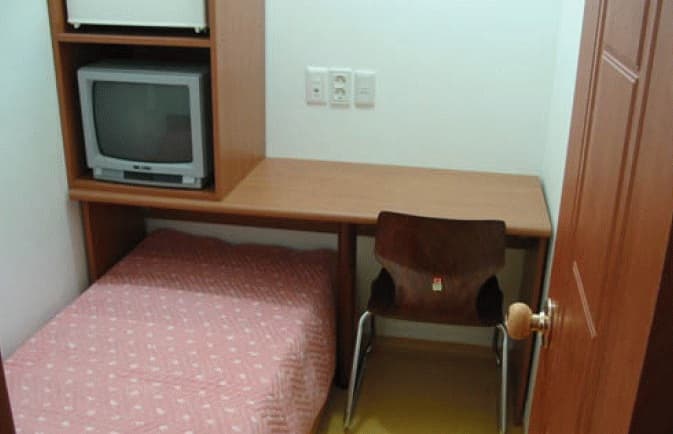
(The goshiwon where I lived)
It was painting and hauling plywood, and I did it for about two months. The boss treated me well, but most of the men I met on site were the worst kind of company. Conversation almost always drifted toward drinking stories and tales of getting women blackout drunk, the usual bravado about sleeping around. They kept telling me that if I stuck around I could become an oya, a kind of crew foreman, and I was sharp enough that I probably could have, especially since I could handle Excel and put together the forms that needed to be submitted to the city, which made them fond of me. But that wasn't the life I wanted. I realized that if I kept at it there would be no way out. The pay for temporary work was surprisingly decent, which was a genuine relief. Construction labor isn't a bad thing in itself, but most of the men around me carried a kind of chip on their shoulder, and the work was anything but stable. The thought that this might be where my life was heading frightened me. So I set off for Seoul. I still had debt, and my parents gave me 2 million won as a fresh-start fund, which I used to move into a goshiwon. It was the Haengbok Goshiwon in Sinseoldong, the cheapest place in the neighborhood: 320,000 won for a room with a window, 300,000 for one without.
I stayed in the 300,000-won room. The area was full of women who sold their bodies out of nearby inns, and one of the male residents was drunk every single day. Across the hall lived a guy who watched horse racing around the clock. The place was full of all sorts of people, and I was just one more of them. Inside the Sinseoldong Haengbok Goshiwon, once I set up my computer there was no room for a chair, so I sat cross-legged on the bed writing résumés; when it got too hot I went to the PC bang next door. That place had a guy who was in love with a cat rescue volunteer. He scraped by on part-time work. The PC bang had two floors, and on the third floor there was a smoking room where a Game item-farming operation was running. I spent that summer there drinking 1,000-won canned drinks. I took every day-labor gig I could find: hotel temp work, cleaning, moving, you name it. Between the two or three jobs I'd take in a single day, I must have clocked well over a hundred of them by the end. Then I landed something that was technically employment. I joined a System Integration (SI) company, though not as a regular employee; I came in as the representative of a subcontracting entity. It was a freelance contract arrangement, and I didn't fully understand at the time how that was even possible. What I didn't know then was that it was convenient for them because it meant no severance pay obligations. Having graduate school experience on my résumé helped. The company was a telecommunications equipment and infrastructure firm. My job was to take code written by Chinese developers, insert Korean translations provided by a Korean-Chinese interpreter into the codebase, handle error log output, and do various bits of miscellaneous coding. That's how I learned to code, working alongside those Chinese developers. They were all elite graduates from Tsinghua University, and they were incredibly kind to me. It was a period when Chinese companies were entering the Korean market and using Korea as a test bed.
The work wasn't bad. Most of those Chinese programmers weren't just good; they were exceptional, and all I had to do was fit my piece into their framework, adapting the Korean-Chinese translator's text to read naturally in Korean and making small fixes when real bugs came up. Then COVID hit. All the Chinese developers went back home. Six months of experience felt embarrassing to even call experience, and the boss said he'd be in touch later, then went silent, after settling up the money, at least. With no income, I enrolled in a government-funded game development academy; at least the stipend covered some expenses. I had a basic foundation in code from whatever I'd picked up in graduate school, but the academy itself was a waste of time, even if the government funding kept a little money coming in. After paying rent, though, I had to go without food two days a week, so I came back down to Ulsan just to survive. During COVID, even simple day-labor work had dried up entirely, and because of social distancing measures I had relocated from Seoul to Ulsan and was studying remotely. As it happened, the boss who first hired me found out I was in Ulsan and brought me along to a factory there, where I worked with a local manufacturer. That was my first factory project. I encountered Windows Forms (WINFORM) for the first time. It wasn't anything grand; the work was modernizing an aging WINFORM legacy codebase, writing the program that registered items when a barcode was scanned at a logistics center, and handling factory User Interface (UI) work more broadly. The model was simple: a Programmable Logic Controller (PLC) backend would be provided, and I only needed to implement the front-end UI. When the COVID period wound down, I went back up to Seoul in 2021. The government-funded program also happened to ask attendees to visit Seoul in person now that restrictions were lifting. Factory coding wasn't bad work, but the fundamental reality of it was that jobs came through an original contractor who had set up a subcontracting shop, which meant everything depended on personal connections, and the monthly pay rarely broke 2 million won, which was unsettling. (Projects paid as lump sums, stretched over two months.) I wanted to get into a decent company in Seoul. I interviewed at several places. Most of them dismissed me outright. In one programming interview I brought up SOLID principles and said I didn't think following them was strictly necessary, drawing on things I'd read in clean code and Object-Oriented Programming (OOP) books; the interviewer waved me off, saying I clearly didn't know what I was talking about, and pivoted to lecturing me about inheritance and method overriding in Java. I was right, of course. I'd arrived at that view by working through actual academic papers, after all. To make ends meet at that point, I signed up on the freelance platform Kmong. Not long after registering and starting freelance work there, one SI company reached out saying they'd send me projects. They focused on PHP work deployed to platforms like Cafe24 and Gabia, and the vast majority of their sites were gambling or fraud operations. I did the first couple without realizing it, but eventually understood these were unlicensed outfits and stopped. The silver lining was that I came away with real shopping mall code and website templates. (The pattern was: they'd ask you to write code against a template under the pretense of building a legitimate CMS, and once it was live they'd swap in the gambling content.)
After that, the work I did most often was building datasets and research materials for undergraduate and graduate students, along with handling graduation project assignments fairly regularly. Clients ranged from Seoul National University to KAIST to Korea University of Science and Technology, and quite a few passed through my hands.
While living in Seoul during that period, I was stabbed. A man with schizophrenia had gotten into an argument with the goshiwon owner over unpaid rent and, in a fit of rage, swung a kitchen knife; the blade caught me on the right side of my abdomen. I also ended up at Hyehwa Police Station for a bit. Because of the incident, the goshiwon owner said he couldn't keep running such a worn-down place and was thinking of shutting it down. I started making preparations to go back to Ulsan as well. The shared bathrooms and showers were badly deteriorated, and from what I heard there were fire code violations on top of everything else. After leaving the goshiwon, I briefly joined a company and worked on a large project, a 20-million-won contract. It involved writing code for various pieces of equipment, and I coded each of roughly 20 machines one by one. That kind of factory coding meant checking that everything operated according to the work order, then verifying against the actual machines, and I gained real confidence through that work. I thought maybe I'd finally found my footing as a programmer. But then, while trying to rent a place using the money I'd saved, I got scammed; the landlord had already signed a lease with someone else. I managed to live there barely a year. It was 2023. I came back down to Ulsan and moved back in with my family. I told my parents I'd used the money I had in Seoul to pay off debt, and that I still had about 4 million won left. The truth was it was closer to 7 million at the time. By that point I had given up on marriage, and kmong permanently banned me around the same time for soliciting off-platform transactions. kmong bans you if you conduct payments directly to a bank account instead of through their platform. The problem was that kmong had been my source of trust and reviews, and that's where the work had come from. But with kmong gone and the Ulsan factory company having shut down while I was in Seoul, I was left with nothing. It was genuinely maddening. In 2023 I started using GPT a little and took that time as an opportunity to study on my own. I read actual programming research papers and English-language documentation, almost cover to cover. Time was all I had. Around then I reconnected via WeChat with the Chinese developer who had attended Tsinghua, and through conversations with overseas developers I realized just how narrow my programming world had been. Exchanging emails with developers abroad, getting code reviews, receiving book recommendations, talking through Discord, the key was gaining the right keywords. I'd drop into Twitch streams of former Google engineers doing game development and strike up a conversation, and everyone was uniformly kind, recommending books and pointing me in new directions. There were SAP programmers too, and every one of them opened up a wider world for me. That's how I got through until 2024, doing day-labor construction work, picking up occasional small gigs through personal connections, and reading papers all the while. Still, as the saying goes, there's always a way out even when the sky falls: fortunately, the students I had helped went on to master's and doctoral programs, and when they needed datasets for their theses they came back to me, I found what they needed, and I held on with one single-minded goal of making a game. The debt had shrunk considerably. I'd brought it back down to 2 million won.
In 2024, however, I tried purchasing game assets and wired 3.3 million won to an artist who took the payment and never delivered the art. I ended up abandoning the game release entirely. Even so, work on hotel room-pad systems and a drone-related project brought in a little money, and several Windows Presentation Foundation (WPF) projects for Point of Sale (POS) system companies helped as well.
By 2024, though, as GPT became mainstream, signs began to appear that my market value was eroding, and from 2025 onward the bottom essentially fell out of the market. Work that had previously fetched 300,000 to 500,000 won, even for minor tasks, because it was programming work, dropped to as low as 100,000 won per job. Landing page projects that used to go for 1 million won were down to 200,000.
In 2025, I started using Soomgo. I was fortunate that existing clients were willing to connect with me there, and they wrote me early reviews on the platform, which helped me bring in new customers. I also started a business in 2025. To be precise, whereas before I had been engaged as a freelancer working under someone else, I am now registered as a genuine self-employed individual (sole proprietor).
And in early 2026, I paid off all my debt. The smart farm project was the biggest factor. When I tallied everything up, the smaller jobs came to over 400, and the corporate transactions exceeded 40. Once the debt was gone in 2026, a thought occurred to me: I want to make a name for myself as a programmer in my own right. I've lost touch with my overseas developer friends (probably because I was always the one asking for things and it got tiresome for them), but following their advice, I've been exploring open source projects and getting active on Hacker News. I also revived the technical blog that had gone dark. I've been programming since the Flash era and knew the technology of that time, but when the Egloos blogging service shut down, ten years' worth of knowledge and diary entries vanished with it. So I built my own personal website using what I'd learned, starting from IPv6 and incorporating the best of everything I'm capable of. I also tested for every OWASP violation I could think of (though I'm not a security specialist, so I'm sure it can still be breached). The corporate transactions are mostly in the 200,000 to 300,000 won range per individual project, so calling them corporate work is a bit of a stretch, but a deal is a deal. What I do have is a project count that far exceeds most programmers my age. And I've talked with developers in China, the United States, the United Kingdom, Germany, and Japan, and I know where they get their information, which I think gives me something uniquely my own. For now, I've survived another year. My bank balance is at zero and there's no romantic life to speak of. AI is always tightening its grip around my throat, but I've also gotten pretty good at using AI in return. Either way, I'm still here, still moving forward. Success seems quite distant to me, honestly. But I'm still alive and still going.