
Not long ago, I had dakgalbi with a Vietnamese friend I was close with at Sungkyunkwan University. He mentioned he's working as an assistant professor in Vietnam and asked what I was up to. I mumbled something about being a CEO of a startup, but the truth is I'm just a Freelancer in name, and lately I'm barely making 1.5 million won a month. There were times I made 20 million, even 11 million in a single month. Honestly, since AI came along, even that has nearly dried up. The money I had saved up went toward buying my younger sister a laptop (this year, thanks to AI, I spent 2.2 million won on a notebook) and paying off debts from a scam I fell victim to, so here I am at 34, basically broke. The future looks bleak. One notable thing I finished this month was a coding project for a lab at Seoul National University's engineering school (not the computer engineering side).
Personally, I don't think professors are all that competent across the board; most of them tend to be stuck in the technology they learned during their PhD years. The code in question was from an engineering professor, and the job was migrating C++ 98-era code to modern C++ 23. The professor lamented that students these days don't learn C++, but I didn't see it that way. I thought the real reason was that the professor's technology stack was too Legacy, but since he paid well and treated me kindly, I never brought that up.
Having spent time in this programming industry, it's common to see professors looked down upon both at service companies and at System Integration (SI) firms. The reason is simple: professors genuinely lack knowledge of the core application layers that SI deals with. Conversely, SI practitioners tend to have absolutely no understanding of what professors do.
This is almost inevitable, because academia, represented by LeetCode-style algorithm problems, focuses on computational models and foundational principles, teaching programming that isn't meant to be reused, while SI and practical coding are largely about function and method naming, libraries, and issues of code cohesion and coupling. So there really are quite a few points of divergence, even for computer science graduates.
Of course, I've also seen absurd code at SI firms where someone crammed 20,000 lines into a single function, so it's all relative. And yes, there are programmers in industry who do R&D, but the vast majority tend to quietly assemble libraries and frameworks sponsored by large Western companies.
In other words, professors are strong on the hardware side, but there are quite a few who are weak in software engineering practice. As a result, there are real gaps between real-world work and the computer science curriculum. Practical programming is, for the most part, about assembling libraries within a framework, yet schools don't teach concepts like Inversion of Control (IoC). Students learn Object-Oriented Programming (OOP), but they typically aren't taught how to build a graph of objects, how to connect them, and how to separate and partition them. Even after learning OOP, most people don't realize that understanding how to compose systems requires entirely separate books. Although the department is called computer engineering, Korea's university curricula are in practice closer to computer science, and most of the focus is on OS Kernels, while the majority of actual jobs in Korea exist at higher abstraction layers rather than low-level layers like OS Kernels. The result is that professors claim to understand programming well while being ignorant of software engineering design patterns, and industrial programmers, whether at SI firms or service companies, are so accustomed to assembling libraries behind the abstraction wall the framework provides that they are weak on low-level mechanisms.
The point is that programming is divided into very finely layered specializations, yet people lump it all together as one field and end up looking down on each other. Practitioners dismiss professors for being unable to do real-world work; professors dismiss practitioners for not knowing theory. Watching from the sidelines, it's almost amusing how textbook the frog-in-a-well thinking is, where each side assumes their own knowledge is the whole picture.
In fact, if you look at overseas activity, you can find the names of quite a few Korean professors. Most of them have spent years maintaining Open Source projects, especially in the Linux ecosystem, and are genuinely seasoned in that world. But the reality that you'd rarely have occasion to actually use their work on the job reinforces those dismissive attitudes.
A lot of people make the mistake of assuming that working on a narrow slice of OS architecture automatically makes someone good at building application software. Yet in programming communities, you get gatekeeping of the "you need to have built an OS" or "you need to have built a compiler" variety. Setting aside the tired "reinventing the wheel" argument, the reality is that almost no one in Korea has built an entire OS architecture from scratch; most people only touch specific module optimizations, and yet there seems to be a real lack of metacognition about that. Thinking in invariants, tracking state transitions, having an intuitive sense of performance costs, these are genuine programming skills, but they operate differently at low-level versus high-level layers, and that nuance tends to get lost.
Anyway, that's not the main point. A student I used to tutor reached out to say they got a job at a game company. I was glad to hear it, though I'm honestly not sure what I did that was worth contacting me about. It felt good, but I'm a bit puzzled.
Honestly, I've been worrying a lot lately. A friend who works at Naver is doing pretty well, complaining about Legacy technology on a team-by-team basis, while my own situation is anything but comfortable.
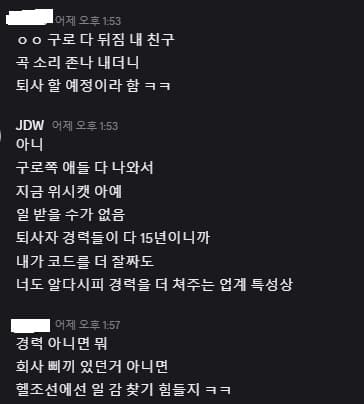
The IT sector I'm in has completely fallen apart. Even the older guys who used to work in the Guro area are asking around about how many gigs are available, which tells me things have gotten really bad.
Most of the work I used to handle on my own has simply vanished.
There used to be a handful of small ERP projects, but most of those have been brought in-house, and as Claude Code and Codex-style workflows have taken hold, work has dried up entirely except for the occasional small RAG implementation request.
A friend I talk to regularly has been venting about the same thing. There's been talk of a large SK-side project, and some people were asking me to jump in on it, but personally, the cleanroom suits aside, the security requirements are so strict that I have no desire to go in. Realistically, I also have no interest in working without AI coding tools these days. On top of that, the middleman fees were so large that the actual take-home was far too small.
Come to think of it, after coding almost exclusively with AI lately (from GPT 5.2 onward I basically couldn't beat it anymore; a friend at Naver also mentioned heavy AI coding use, so it seems like many Korean developers reached the point of not being able to outpace it around that time), I tried going back to writing code by hand and found my instincts had atrophied so badly that I've been doing one hour of hand-coding every day, and even that is brutal.
For now, the older guys and friends in the industry are saying Korean IT will be in rough shape for at least three years, and I have no idea if I can hold on. These days I've been grinding away at writing comments on Hacker News and contributing to a few Open Source projects to try to build a name for myself.
I've been mostly ignored. A few Upwork agencies did throw some work my way, but I have no idea how long that will last.
The current reality is that everyone is practically being forced to use AI, and even that AI usage feels like something only people with established track records are really permitted to do.
On top of that, platform fees on Wishket and other Freelancer marketplaces have gone up, making it even harder to make ends meet.
I really need to ship a product and make a living as an app publisher, but I have no idea what I should actually do. I genuinely don't know how I'm going to survive.
I've pretty much given up on building a name internationally. I went through a few English interviews on Upwork, but my speaking is terrible (my listening was the real problem), and the agencies all turned me down. Still, I did deliver a few small games related to casinos, work that most people avoid.
How am I supposed to make it?
Since AI came along, I've had a fixed monthly cost of 600,000 won just for AI subscriptions, and that's another thing I worry about. People suggest switching from subscriptions to the API, and I did think about it, but when I actually tried the API, I saw 300,000 won disappearing in a single day and gave up on that idea. But not using AI at all isn't an option either, because the market these days simply doesn't hand out timelines as generously as it used to. Being told to build a Landing Page in three days without AI, is that even realistic?
And even that Landing Page work, everyone is scrambling for it. An apartment Landing Page that used to go for 600,000 won is now 150,000 won. That's genuinely baffling. Businesses with established long-term clients might be in a different situation, but as an individual, it's enough to make your head spin.
When will I meet someone to date, when will I get married, and before any of that, when will my bank balance climb back above 1 million won?
A lot on my mind.