

1. Why Was R Created?
To understand the roots of R, you first need to know the S language.
In the late 1970s through the 1980s, researchers at Bell Labs in the United States created a language called S to make statistical analysis more flexible.
The problem at the time was straightforward.
Existing statistical software often provided only a fixed set of functions,
and it was difficult for users to programmatically extend the analysis procedures themselves.
Researchers wanted an interactive environment where they could "work with data on the fly, modify models, and draw graphs."
In other words, S was not meant to be a simple calculator; it aimed to be:
"A programming language for statistical analysis"
This philosophy was later carried over directly into R.
This philosophy was later carried over directly into R.
2. The Direct Origins of R
R was created in the early 1990s by Ross Ihaka and Robert Gentleman at the University of Auckland in New Zealand.
The two were influenced by the S language and saw the need for a statistical language that could be used more freely.
The key background is as follows.
S was excellent, but it was heavily shaped by commercial and restrictive environments.
Research and educational settings needed a more freely available implementation.
An open system was needed where statisticians could extend and share their work directly.
So the two created a new language with a philosophy similar to S, and that language is R.
3. Why Is It Called R?
This is a fairly well-known story.
The name R is typically explained on two levels.
3.1 The First Initial of the Creators' Names
Ross Ihaka
Robert Gentleman
Both of their first names begin with the letter R.
3.2 The Meaning of Being S's Successor
R also carries the philosophical meaning of being the successor to S. Alphabetically it comes before S, but the stronger symbolism is that it represents "an open implementation that inherits from S."
More precisely, the name conveys more than just simple naming:
A free implementation of the S-family statistical language
is the identity the name expresses.
4. The Release and Growth of R
From the mid-1990s, R began to be distributed publicly on an increasing scale, and the pivotal turning point was its open-sourcing.
Why did this matter?
Statisticians around the world could directly create packages,
universities, research institutes, and companies could use it for free,
and a culture emerged where the authors of a paper introducing a new statistical method would immediately release an R package to go with it.
In other words, more than the language itself,
"an ecosystem for sharing statistical knowledge directly as code"
was what drove R's explosive growth.
5. The Emergence of CRAN and the Explosion of the Ecosystem
What truly mattered in R's history was not just the language syntax but CRAN.
CRAN (Comprehensive R Archive Network) is a massive repository network for distributing R packages, source code, documentation, and more.
The changes it brought:
Anyone could publish a package.
Packages for specific fields accumulated rapidly.
Tools expanded across domains including statistics, bioinformatics, econometrics, time series, machine learning, and visualization.
Researchers around the world shared knowledge in the form of "paper + R code + package."
In other words, R became not merely a single language but:
A package-centric academic ecosystem.
If Python layered a data ecosystem on top of a general-purpose language, R was a language born from the very beginning with data analysis and statistics at its core.
6. Why R Became So Powerful
The reasons R has survived so long are clear.
6.1 Statistician-Friendly
R was built from the ground up for statistical analysis, so concepts like regression, hypothesis testing, ANOVA, time series, and survival analysis are deeply embedded in the language's culture.
6.2 Data Frame-Centric Thinking
R has a very strong orientation toward working with data in tabular form, which makes it a natural fit for real-world data analysis tasks.
6.3 Visualization Strengths
The built-in plotting capabilities were already strong, and with the later arrival of packages like ggplot2, a grammatical and declarative approach to visualization became the standard.
6.4 Reproducibility
With the rise of R Markdown, Sweave, knitr, and similar tools, a culture developed around bundling "analysis code + results + documentation" into a single artifact.
In other words:
rather than finishing an analysis and moving on, the culture of leaving that analysis reproducible
is one of the great strengths of the R ecosystem.
7. The Historical Differences Between R and Python Today
Since there is a growing trend of using Python for statistics, it is worth summarizing the historical differences between the two.
R
Starting point: statistics
Identity: closer to a dedicated analysis language
Strengths: statistical modeling, visualization, research culture, package ecosystem
Python
Starting point: general-purpose programming
Identity: general-purpose language
Strengths: web, automation, systems, AI, and data engineering across the board
In short, both are used for data analysis, but their histories are different.
R is a language that started in statistics and expanded outward.
Python is a general-purpose language that moved into the data domain.
As a result, R's syntax and culture strongly feel like they were designed with the mindset of a statistician, while Python tends to have a stronger software-engineering consistency.
8. Before and After the tidyverse
Another important event in R's history is the rise of the tidyverse movement.
Early R was powerful, but it had the following problems.
Syntax was often inconsistent,
it was somewhat difficult for beginners to read,
and the base R style varied noticeably from function to function.
Later, led by Hadley Wickham, the tidyverse movement took hold, bringing together packages such as ggplot2, dplyr, tidyr, readr, purrr, and tibble.
What this changed:
Consistency in data manipulation syntax was greatly improved.
A readable, pipeline-style workflow became the norm.
The concept of "tidy data" became widespread.
Modern R usage was standardized.
In short, historically R has evolved:
Early R = a powerful but rough tool centered on statisticians
Modern R = a language with a well-organized data analysis workflow
로 발전했다.
9. Fields Where R Is Widely Used
R is particularly strong in the following fields.
Statistics
Bioinformatics
Medical and pharmaceutical statistics
Social science data analysis
Econometrics
Time series analysis
Academic research
Experimental result analysis
Automated report generation
Especially in paper-based analysis culture, the pattern of "new method published, R package released" was very common. As a result, for a long time the latest statistical methods were often implemented in R first.
10. R Has Its Limitations Too
Describing only the strengths when explaining history tells only half the story.
10.1 Weak for General Software Development
R was not designed as a language for building large-scale applications, so it is at a disadvantage compared to Python, Java, TypeScript, or C# for things like web servers, large-scale systems, and complex backend design.
10.2 Performance Limitations
While vectorized computation is a strength, there are constraints in overall system programming performance and memory management.
10.3 Language Consistency Issues
Because of its long history, base R, formulas, S3, S4, R6, tidyverse, and other styles have layered on top of one another. It is powerful, but the language does not give the impression of being "cleanly unified under a single philosophy."
11. Is It Still Worth Learning R Today?
Yes. But the purpose matters.
Cases where it is well worth learning
You want to work deeply with statistics itself.
Your focus is data analysis and reporting.
You need a strong tool for organizing research or experimental results.
You want to learn a visualization grammar at the level of ggplot2.
You work in academic, pharmaceutical, or biostatistics fields.
Cases where it is relatively less suitable
Your goal is general-purpose backend development.
You want to build an entire product-style service.
Your focus is on system integration, servers, deployment, or web apps.
In short, R is not a dead language; it is a language with a very clear purpose.
12. Closing Thoughts
The history of R can be summarized as follows.
Inheriting the philosophy of Bell Labs' S language, an open-source statistical language born at the University of Auckland in the 1990s grew alongside a package ecosystem built by researchers around the world.
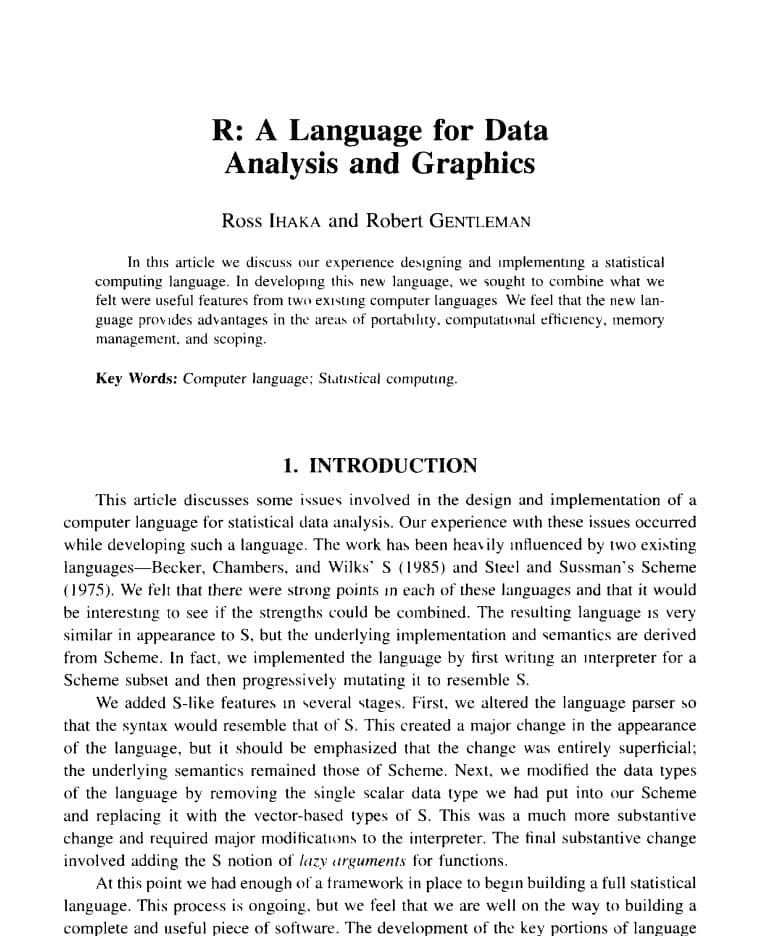
Reference: R: A Language for Data Analysis and Graphics (1996)
Reference 2: https://cran.r-project.org/doc/manuals/r-release/R-lang.html Official R documentation
Reference 3: https://cran.r-project.org/
- Ihaka, R., Gentleman, R. (1996). R: A Language for Data Analysis and Graphics- Chambers, J. (1998). Programming with Data- R Core Team. An Introduction to R- CRAN (Comprehensive R Archive Network)- Wickham, H. R for Data Science- Wickham, H. Advanced R- The R Project for Statistical Computing (official website)